


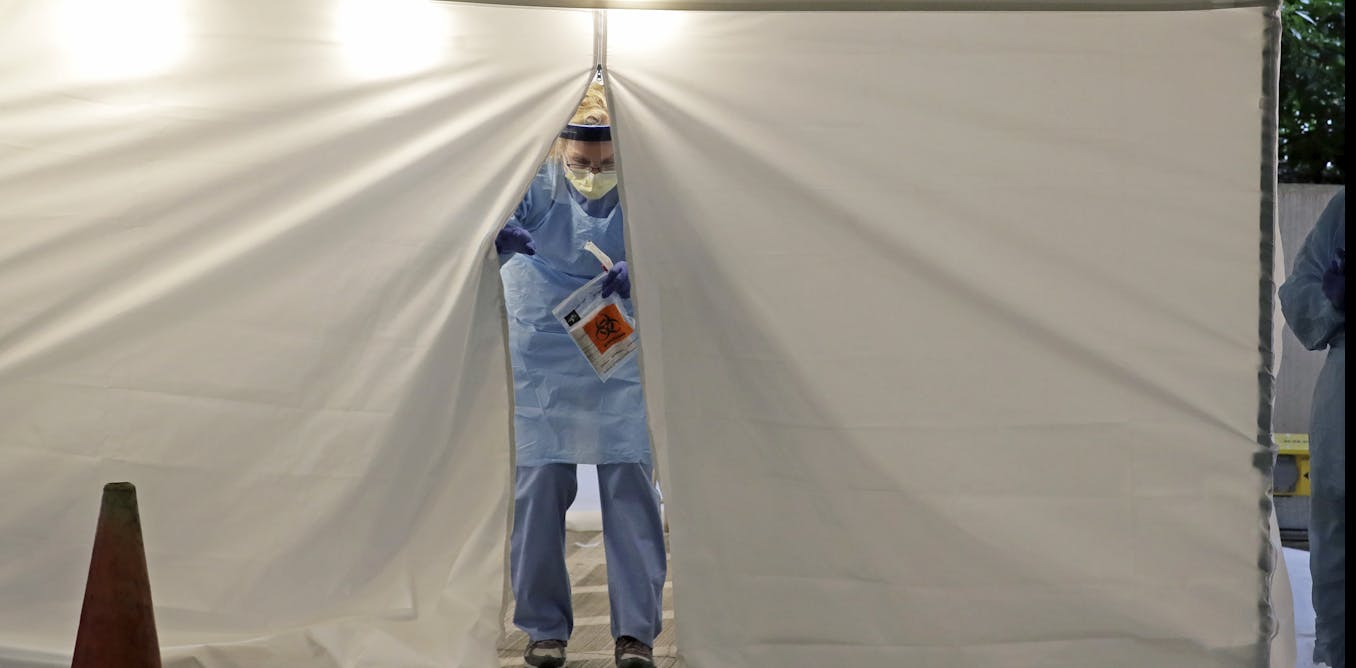
Even as China, South Korea and Singapore make progress controlling the new coronavirus, its spread raises alarm in many more parts of the globe as the pathogen’s toll on human health and world economies climbs.
In the past week many more citizens have had to stay at home in the hope that infection rates can be slowed to prevent health systems being overwhelmed. The collapse in consumer activity has sent stock markets swooning, prompting governments and central banks to take steps to soften the blow of an expected global recession.
At the same time, public health authorities around the world are devising strategies to contain the spread, hoping to avoid the plight of the worst-hit countries, such as Iran and Italy, which has now has had more deaths than China from the virus.
At The Conversation, editors have been working closely with academic experts in a range of disciplines from around the world to convey the scope of this fast-moving story and to help readers understand what it all means. In this third weekly column, here are some of the themes editors at The Conversation International network covered.

This is our weekly roundup of expert info about the coronavirus.
The Conversation, a not-for-profit group, works with a wide range of academics across its global network. Together we produce evidence-based analysis and insights. The articles are free to read – there is no paywall – and to republish. Keep up to date with the latest research by reading our free newsletter.
Public health responses
Public health agencies have responded to the crisis in very different ways. Our experts explained how critical those differences are to each country’s trajectory thus far and, potentially, in the future.
-
Singapore, the model response? Singapore, which suffered from the SARS epidemic in the early 2000s, had a highly organized response that, among other things, avoided a lockdown. The chair of infection control for National University of Singapore, Dale Fisher, explains how the country did it and the lessons for other countries.
-
South Korea’s contact tracing. South Korea, too, has been held up as a global model. One interesting aspect of its response is its acceptance of surveillance systems, notably CCTV and the tracking of bank card and mobile phone usage, to control the spread of COVID-19, the disease caused by the coronavirus.
-
The picture in Africa. There have been comparatively few reported cases in Africa so far. Akebe Luther King Abia, research scientist from University of KwaZulu-Natal in South Africa explains why that might, adding that countries on the continent need to do much more to prepare their health systems and public responses. Meanwhile, among many people in South Africa, joking is a common way to cope.
Grim economic outlook
Even as governments deal with the pandemic, they are trying to forestall what’s expected to be widespread economic pain caused by the halt of so much economic activity. In the U.S., the White House and Congress are seeking to spur economic activity through multiple measures, including tax cuts, business loans and handing out money to families, on the order of US$1,200 per taxpayer.
-
Direct payments to citizens are particularly beneficial to low-wage workers, many of whom will be hurt by the slowdown in consumer spending, says economist Steven Pressman from Colorado State University.
-
Low to middle-income countries more vulnerable. Globally, the impact of the coronavirus could be worse on low to middle-income countries and harm particularly vulnerable people, say professor of public policy David Evans of Pardee RAND Graduate School and Mead Over of Georgetown University. As previous pandemics have shown, the short-term shocks on the economy typically translate into slowing long-term growth.
On the front lines of science
Scientists are racing to get a better understanding of the novel coronavirus, known as SARS-CoV-2.
-
Seeking the virus’s origin. Researcher Alexandre Hassanin, of Sorbonne Université, ISYEB – Institut de Systématique, Evolution, provides some context for one of the most vexing questions facing scientists: did it originate in a bat or pangolin and where? He describes a recent genetic analysis which suggests that the “SARS-Cov-2 virus is the result of a recombination between two different viruses.” (To read the original article in French, click here.)
-
The quest for anti-viral treatments. Could existing drugs work? Nevan Krogan, who is director of Quantitative Biosciences Institute at the University of California, San Francisco, describes the work of a 22-lab research team working around the clock to identify the most promising candidates for disarming this new virus.
-
The biology of why elders are more at risk. As scientists generate new data on how COVID-19 affects people, one point is very clear: Older people and those with chronic medical conditions are most at risk of serious illness or death. Brian Geiss, associate professor of microbiology, immunology and pathology at Colorado State University, explains how changes to a person’s immune system as we age affects its ability to fight off infections like COVID-19.
Changes to daily life
For people who remain healthy and staying at home, the virus has upended many lives.
-
Confused children. Child development experts from the University of Calgary explain how parents can talk to their children about the pandemic.
-
Complex daily decisions. Many people isolating themselves at home still have questions. Adam Kamradt-Scott from the University of Sydney gets into a more nuanced discussion around social distancing and tries to answer basic questions such as: Can I take the dog for a walk?
-
The psychological toll. Finally, one common thread across all countries is stressed-out individuals. Nita Bharti from the Center for Infectious Disease Dynamics at Pennsylvania State University offers some tips on how to maintain physical and mental health during this period.

Get the latest news and advice on COVID-19, direct from the experts in your inbox. Join hundreds of thousands who trust experts by subscribing to our newsletter.
Even as China, South Korea and Singapore make progress controlling the new coronavirus, its spread raises alarm in many more parts of the globe as the pathogen’s toll on human health and world economies climbs.
In the past week many more citizens have had to stay at home in the hope that infection rates can be slowed to prevent health systems being overwhelmed. The collapse in consumer activity has sent stock markets swooning, prompting governments and central banks to take steps to soften the blow of an expected global recession.
At the same time, public health authorities around the world are devising strategies to contain the spread, hoping to avoid the plight of the worst-hit countries, such as Iran and Italy, which has now has had more deaths than China from the virus.
At The Conversation, editors have been working closely with academic experts in a range of disciplines from around the world to convey the scope of this fast-moving story and to help readers understand what it all means. In this third weekly column, here are some of the themes editors at The Conversation International network covered.
This is our weekly roundup of expert info about the coronavirus.
The Conversation, a not-for-profit group, works with a wide range of academics across its global network. Together we produce evidence-based analysis and insights. The articles are free to read – there is no paywall – and to republish. Keep up to date with the latest research by reading our free newsletter.
Public health responses
Public health agencies have responded to the crisis in very different ways. Our experts explained how critical those differences are to each country’s trajectory thus far and, potentially, in the future.
-
Singapore, the model response? Singapore, which suffered from the SARS epidemic in the early 2000s, had a highly organized response that, among other things, avoided a lockdown. The chair of infection control for National University of Singapore, Dale Fisher, explains how the country did it and the lessons for other countries.
-
South Korea’s contact tracing. South Korea, too, has been held up as a global model. One interesting aspect of its response is its acceptance of surveillance systems, notably CCTV and the tracking of bank card and mobile phone usage, to control the spread of COVID-19, the disease caused by the coronavirus.
-
The picture in Africa. There have been comparatively few reported cases in Africa so far. Akebe Luther King Abia, research scientist from University of KwaZulu-Natal in South Africa explains why that might, adding that countries on the continent need to do much more to prepare their health systems and public responses. Meanwhile, among many people in South Africa, joking is a common way to cope.
Grim economic outlook
Even as governments deal with the pandemic, they are trying to forestall what’s expected to be widespread economic pain caused by the halt of so much economic activity. In the U.S., the White House and Congress are seeking to spur economic activity through multiple measures, including tax cuts, business loans and handing out money to families, on the order of US$1,200 per taxpayer.
-
Direct payments to citizens are particularly beneficial to low-wage workers, many of whom will be hurt by the slowdown in consumer spending, says economist Steven Pressman from Colorado State University.
-
Low to middle-income countries more vulnerable. Globally, the impact of the coronavirus could be worse on low to middle-income countries and harm particularly vulnerable people, say professor of public policy David Evans of Pardee RAND Graduate School and Mead Over of Georgetown University. As previous pandemics have shown, the short-term shocks on the economy typically translate into slowing long-term growth.
On the front lines of science
Scientists are racing to get a better understanding of the novel coronavirus, known as SARS-CoV-2.
-
Seeking the virus’s origin. Researcher Alexandre Hassanin, of Sorbonne Université, ISYEB – Institut de Systématique, Evolution, provides some context for one of the most vexing questions facing scientists: did it originate in a bat or pangolin and where? He describes a recent genetic analysis which suggests that the “SARS-Cov-2 virus is the result of a recombination between two different viruses.” (To read the original article in French, click here.)
-
The quest for anti-viral treatments. Could existing drugs work? Nevan Krogan, who is director of Quantitative Biosciences Institute at the University of California, San Francisco, describes the work of a 22-lab research team working around the clock to identify the most promising candidates for disarming this new virus.
-
The biology of why elders are more at risk. As scientists generate new data on how COVID-19 affects people, one point is very clear: Older people and those with chronic medical conditions are most at risk of serious illness or death. Brian Geiss, associate professor of microbiology, immunology and pathology at Colorado State University, explains how changes to a person’s immune system as we age affects its ability to fight off infections like COVID-19.
Changes to daily life
For people who remain healthy and staying at home, the virus has upended many lives.
-
Confused children. Child development experts from the University of Calgary explain how parents can talk to their children about the pandemic.
-
Complex daily decisions. Many people isolating themselves at home still have questions. Adam Kamradt-Scott from the University of Sydney gets into a more nuanced discussion around social distancing and tries to answer basic questions such as: Can I take the dog for a walk?
-
The psychological toll. Finally, one common thread across all countries is stressed-out individuals. Nita Bharti from the Center for Infectious Disease Dynamics at Pennsylvania State University offers some tips on how to maintain physical and mental health during this period.
Get the latest news and advice on COVID-19, direct from the experts in your inbox. Join hundreds of thousands who trust experts by subscribing to our newsletter.