


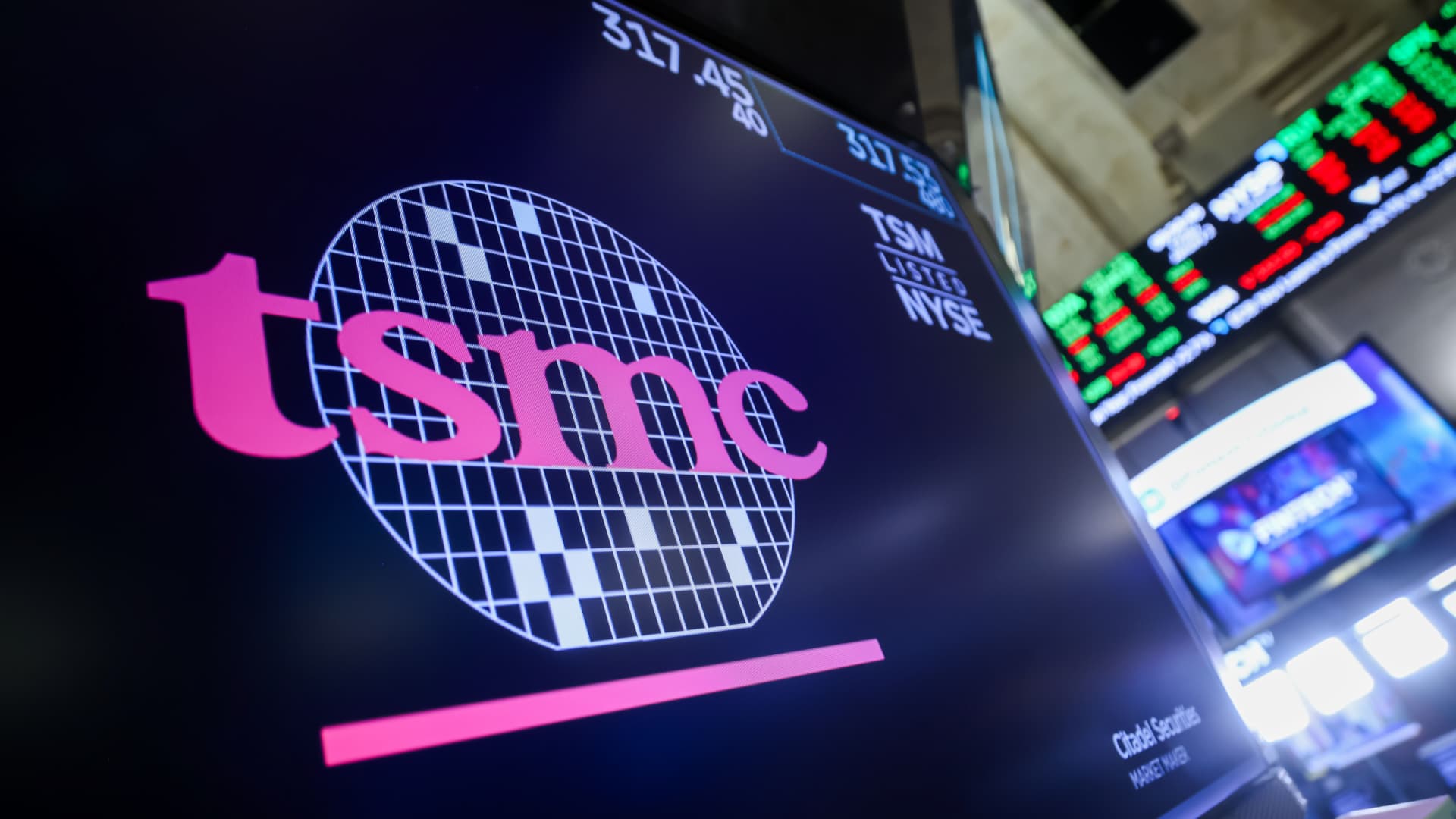
Taiwan Semiconductor Manufacturing Co. (TSMC) signage on the floor of the New York Stock Exchange (NYSE) in New York, US, on Friday, Jan. 2, 2026.
Michael Nagle | Bloomberg | Getty Images
As South Korea’s and Taiwan’s benchmark indexes surged to record highs this year — powered by Asia’s trillion-dollar titans — it has raised concerns that their rallies are becoming dangerously dependent on a handful of artificial intelligence winners.
South Korea’s Kospi index has surged more than 80% this year, hitting one fresh high after another, while Taiwan’s Taiex has also repeatedly posted new records as investors piled into the semiconductor trade at the center of the AI boom.
“In a word, it’s the AI hardware theme that’s clearly what is propelling things,” Goldman Sachs strategist Tim Moe told CNBC.
Taiwan is “well over 80%” exposed to AI-related revenue streams while South Korea stands around 60%, he said, as soaring demand for memory chips and advanced semiconductors fuels an unprecedented earnings boom.
The concentration is staggering. Taiwan Semiconductor Manufacturing Company, which has a market cap of around 58 trillion Taiwan dollars ($1.85 trillion), now accounts for more than 40% of Taiwan’s benchmark Taiex index, according to UOB.
In South Korea, Samsung Electronics and SK Hynix together made up a record 42.2% of the Kospi in May, according to Manulife Investment Management. Samsung Electronics’ market capitalization pushed past $1 trillion last week as investors continued to chase AI-linked stocks.

Shares of TSMC in the past year
The concentration has made both markets highly exposed to the global AI spending cycle. But it also means index-level gains may say less about broad domestic strength than about the earnings power of a narrow group of exporters.
Analysts warned that reliance on a narrow group of exporters could amplify volatility and leave markets vulnerable to shocks ranging from geopolitical tensions to a slowdown in data-center spending.
“There certainly is risk with market concentration,” Goldman’s Moe said, pointing to vulnerabilities ranging from supply disruptions and political backlash against AI infrastructure to capital-market stress and technological disruption from new chip designs.
One immediate risk stems from the AI supply chain itself. Taiwan and South Korea sit at the heart of a manufacturing ecosystem reliant on specialized chemicals, light-sensitive films known as photoresists and gases that could be affected during geopolitical tensions or disruptions to global shipping routes.
“If you just can’t get them, and therefore you have to stop your production, it would not take a genius to think that the stocks would correct,” Moe said.
Some people say Taiwan is just a one-trick pony. That’s just TSMC. Longer term, it does increase the concentration risk for both the economy and the stock market.
Qi Wang
Chief Investment Officer (Wealth Management)
Additionally, Taiwan and Korea are large energy importers, meaning higher oil prices from Middle East tensions could hurt their purchasing power and international competitiveness, even as AI demand boosts exports.
Jamie Mills O’Brien, investment director at Aberdeen Investments, said both markets “sit on the wrong side of the terms of trade as large energy price importers,” especially at a time when oil prices are rising sharply due to the Iran conflict.
Another threat is the sheer scale of expectations now embedded in valuations. The AI frenzy has already pushed Asian tech earnings sharply higher, with Goldman estimating that South Korean earnings growth could surge 300% this year.
How much does it represent economic growth?
“Korea and Taiwan equity markets have always been more a reflection of global demand, given the vast majority of listed equities are exporters, rather than domestic demand,” said Mixo Das, JPMorgan’s head of Korea and Taiwan equity strategy. “This remains the case; it is simply that global demand has become very concentrated in AI at present.”
While Taiwan and South Korea’s soaring equity benchmarks may look similar on the surface, Goldman’s Moe said that the extent to which they reflect their broader economies is increasingly diverging.
South Korea’s market still captures a relatively broad swathe of the domestic economy despite the dominance of chipmakers such as Samsung Electronics and SK Hynix. Beyond semiconductors, investors are also piling into sectors tied to shipbuilding, defense, power equipment and even the “K-culture” trade, helping make the rally more reflective of Korea’s wider industrial base.
“The market is actually deeper and broader and has more opportunities than just the superstar memory stocks,” Moe said. Korea’s equity gains are better aligned with broader economic strength, including strong exports and swelling current-account surpluses, he added.
Taiwan’s market, by contrast, has become increasingly tied to TSMC and to global semiconductor demand, making it increasingly detached from the domestic economy, Moe said.
Some investors also worry that markets are becoming overly reliant on a single theme continuing indefinitely.
“There is certainly significant crowding in the AI thematic across global equities,” said JPMorgan’s Das. Depending on how broadly AI exposure is measured, “40% to 45% of the S&P 500 is AI-related,” with even higher levels in Taiwan and Korea, he said.

UOB’s chief investment officer Qi Wang warned that Taiwan’s growing reliance on TSMC could create long-term distortions to both the economy and the market.
“Some people say Taiwan is just a one-trick pony. That’s just TSMC,” Wang said. “Longer term, it does increase the concentration risk for both the economy and the stock market.”
Taiwan’s regulators recently relaxed limits on how much domestic funds can allocate to a single stock, a move widely seen as benefiting TSMC. Wang estimated the change could direct $30 billion to $40 billion into the chipmaker alone, potentially reinforcing the very concentration risks policymakers are trying to manage.
Other strategists argue the comparison with other highly concentrated markets is overstated because semiconductors rely on sprawling industrial ecosystems rather than a single commodity or product.
Still, history offers cautionary tales. Denmark and Saudi Arabia, two markets heavily dependent on a single corporate champion, were among the world’s weakest-performing stock markets at the end of last year.
Denmark’s market slumped as concerns mounted over the slowing demand for obesity drugs made by Novo Nordisk, while Saudi Arabia’s equity market, dominated by Saudi Aramco, struggled when oil prices fell. Saudi stocks have since clawed back some ground amid the recent rebound in crude prices.
The lesson for investors is that concentration can be self-reinforcing during bull markets, until sentiment changes. Florian Weidinger, chief executive officer of Santa Lucia Asset Management, warned that many global investors seeking diversification may unknowingly be doubling down on the same AI trade by buying both U.S. megacap technology stocks and Asian benchmarks dominated by semiconductor giants.
“If that were to break,” he said, “a lot of allocators will wake up with double risk.”
Taiwan Semiconductor Manufacturing Co. (TSMC) signage on the floor of the New York Stock Exchange (NYSE) in New York, US, on Friday, Jan. 2, 2026.
Michael Nagle | Bloomberg | Getty Images
As South Korea’s and Taiwan’s benchmark indexes surged to record highs this year — powered by Asia’s trillion-dollar titans — it has raised concerns that their rallies are becoming dangerously dependent on a handful of artificial intelligence winners.
South Korea’s Kospi index has surged more than 80% this year, hitting one fresh high after another, while Taiwan’s Taiex has also repeatedly posted new records as investors piled into the semiconductor trade at the center of the AI boom.
“In a word, it’s the AI hardware theme that’s clearly what is propelling things,” Goldman Sachs strategist Tim Moe told CNBC.
Taiwan is “well over 80%” exposed to AI-related revenue streams while South Korea stands around 60%, he said, as soaring demand for memory chips and advanced semiconductors fuels an unprecedented earnings boom.
The concentration is staggering. Taiwan Semiconductor Manufacturing Company, which has a market cap of around 58 trillion Taiwan dollars ($1.85 trillion), now accounts for more than 40% of Taiwan’s benchmark Taiex index, according to UOB.
In South Korea, Samsung Electronics and SK Hynix together made up a record 42.2% of the Kospi in May, according to Manulife Investment Management. Samsung Electronics’ market capitalization pushed past $1 trillion last week as investors continued to chase AI-linked stocks.
Shares of TSMC in the past year
The concentration has made both markets highly exposed to the global AI spending cycle. But it also means index-level gains may say less about broad domestic strength than about the earnings power of a narrow group of exporters.
Analysts warned that reliance on a narrow group of exporters could amplify volatility and leave markets vulnerable to shocks ranging from geopolitical tensions to a slowdown in data-center spending.
“There certainly is risk with market concentration,” Goldman’s Moe said, pointing to vulnerabilities ranging from supply disruptions and political backlash against AI infrastructure to capital-market stress and technological disruption from new chip designs.
One immediate risk stems from the AI supply chain itself. Taiwan and South Korea sit at the heart of a manufacturing ecosystem reliant on specialized chemicals, light-sensitive films known as photoresists and gases that could be affected during geopolitical tensions or disruptions to global shipping routes.
“If you just can’t get them, and therefore you have to stop your production, it would not take a genius to think that the stocks would correct,” Moe said.
Some people say Taiwan is just a one-trick pony. That’s just TSMC. Longer term, it does increase the concentration risk for both the economy and the stock market.
Qi Wang
Chief Investment Officer (Wealth Management)
Additionally, Taiwan and Korea are large energy importers, meaning higher oil prices from Middle East tensions could hurt their purchasing power and international competitiveness, even as AI demand boosts exports.
Jamie Mills O’Brien, investment director at Aberdeen Investments, said both markets “sit on the wrong side of the terms of trade as large energy price importers,” especially at a time when oil prices are rising sharply due to the Iran conflict.
Another threat is the sheer scale of expectations now embedded in valuations. The AI frenzy has already pushed Asian tech earnings sharply higher, with Goldman estimating that South Korean earnings growth could surge 300% this year.
How much does it represent economic growth?
“Korea and Taiwan equity markets have always been more a reflection of global demand, given the vast majority of listed equities are exporters, rather than domestic demand,” said Mixo Das, JPMorgan’s head of Korea and Taiwan equity strategy. “This remains the case; it is simply that global demand has become very concentrated in AI at present.”
While Taiwan and South Korea’s soaring equity benchmarks may look similar on the surface, Goldman’s Moe said that the extent to which they reflect their broader economies is increasingly diverging.
South Korea’s market still captures a relatively broad swathe of the domestic economy despite the dominance of chipmakers such as Samsung Electronics and SK Hynix. Beyond semiconductors, investors are also piling into sectors tied to shipbuilding, defense, power equipment and even the “K-culture” trade, helping make the rally more reflective of Korea’s wider industrial base.
“The market is actually deeper and broader and has more opportunities than just the superstar memory stocks,” Moe said. Korea’s equity gains are better aligned with broader economic strength, including strong exports and swelling current-account surpluses, he added.
Taiwan’s market, by contrast, has become increasingly tied to TSMC and to global semiconductor demand, making it increasingly detached from the domestic economy, Moe said.
Some investors also worry that markets are becoming overly reliant on a single theme continuing indefinitely.
“There is certainly significant crowding in the AI thematic across global equities,” said JPMorgan’s Das. Depending on how broadly AI exposure is measured, “40% to 45% of the S&P 500 is AI-related,” with even higher levels in Taiwan and Korea, he said.
UOB’s chief investment officer Qi Wang warned that Taiwan’s growing reliance on TSMC could create long-term distortions to both the economy and the market.
“Some people say Taiwan is just a one-trick pony. That’s just TSMC,” Wang said. “Longer term, it does increase the concentration risk for both the economy and the stock market.”
Taiwan’s regulators recently relaxed limits on how much domestic funds can allocate to a single stock, a move widely seen as benefiting TSMC. Wang estimated the change could direct $30 billion to $40 billion into the chipmaker alone, potentially reinforcing the very concentration risks policymakers are trying to manage.
Other strategists argue the comparison with other highly concentrated markets is overstated because semiconductors rely on sprawling industrial ecosystems rather than a single commodity or product.
Still, history offers cautionary tales. Denmark and Saudi Arabia, two markets heavily dependent on a single corporate champion, were among the world’s weakest-performing stock markets at the end of last year.
Denmark’s market slumped as concerns mounted over the slowing demand for obesity drugs made by Novo Nordisk, while Saudi Arabia’s equity market, dominated by Saudi Aramco, struggled when oil prices fell. Saudi stocks have since clawed back some ground amid the recent rebound in crude prices.
The lesson for investors is that concentration can be self-reinforcing during bull markets, until sentiment changes. Florian Weidinger, chief executive officer of Santa Lucia Asset Management, warned that many global investors seeking diversification may unknowingly be doubling down on the same AI trade by buying both U.S. megacap technology stocks and Asian benchmarks dominated by semiconductor giants.
“If that were to break,” he said, “a lot of allocators will wake up with double risk.”