



Stocks close in positive territory
The three major averages finished higher on Friday.
The S&P 500 rose 0.84% to 7,398.93, while the Nasdaq Composite surged 1.71% to 26,247.08. The Dow Jones Industrial Average ticked up 12.19 points, or 0.02%, to 49,609.16.
— Sean Conlon
Rising energy prices will lead to demand destruction: JPMorgan
Consumers will adjust to rising energy prices by reducing demand, economists at JPMorgan said.
Oil prices fell this week as the market hoped for a U.S.-Iran deal, though Brent has since stabilized around $100 per barrel amid a series of violent confrontations in the Persian Gulf.
The supply buffers that have insultated the oil market from the war are eroding, economists at JPMorgan told clients in a Thursday note.
“We expect to see increasing signs of demand destruction as energy product consumers adjust to rising prices,” the economists said.
— Spencer Kimball
S&P 500 could rally to as much as 13,000 in three years, Mary Ann Bartels says
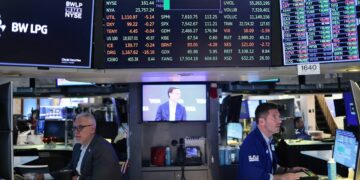
Traders work at the New York Stock Exchange on May 7, 2026.
NYSE
The S&P 500 could rally nearly double in just a few years, Mary Ann Bartels, chief investment strategist at Sanctuary Wealth, told CNBC’s “Power Lunch.”
The “S&P can hit 10,000 to 13,000” in three years, Bartels said Friday.
The broad-market index surged nearly 1% on Friday to a record intraday high north of 7,300 on Friday as companies’ earnings reports continued to come in strong and the U.S. and Iran’s tenuous ceasefire agreement appeared to hold up.
The S&P 500 has gained about 8% since the beginning of the year.
— Liz Napolitano
Michael Burry’s bubble warning
Michael Burry of “Big Short” fame is warning that the stock market’s fixation on artificial intelligence is beginning to resemble the final stages of the dot-com bubble.
“Stocks are not up or down because of jobs or consumer sentiment,” Burry wrote. “They are going straight up because they have been going straight up. On a two letter thesis that everyone thinks they understand. … Feeling like the last months of the 1999-2000 bubble.”
Burry compared the recent trajectory of the Philadelphia Semiconductor Index (SOX) with the run-up that preceded the collapse of technology stocks in March 2000. The index is up more than 10% this week, pushing its 2026 gains to 65%.
— Yun Li
Stocks making midday moves: Fluence Energy, Corpay, Micron
The Micron Technology offices in San Jose, California, Dec. 16, 2025.
David Paul Morris | Bloomberg | Getty Images
Here are the stocks making headlines in midday trading:
- Fluence Energy – The battery storage maker soared almost 30%. HSBC and Roth Capital both upgraded Fluence after fiscal second-quarter earnings before interest, taxes, depreciation and amortization topped Wall Street analyst estimates, according to FactSet. The stock skyrocketed roughly 40% in the prior session.
- Corpay – Shares of the corporate payments company jumped 10% after Corpay lifted its full-year guidance. The company sees earnings ranging from $26.30 to $27.10 per share, versus its earlier outlook for $25.50 to $26.50 a share. Analysts polled by FactSet had estimated $26.05. Adjusted profit and revenue in the first quarter also surpassed estimates.
- Chip stocks – The VanEck Semiconductor ETF (SMH) popped more than 3% to a new 52-week high as investors snapped up shares of chip companies. Micron Technology added 13%, and Qualcomm jumped about 9%. Advanced Micro Devices rose 8%.
Read here for the full list.
— Darla Mercado
How Wall Street’s new NACHO trade bets on a prolonged oil shock
Move over TACO trade. Traders now have a new acronym for a market increasingly skeptical that the Strait of Hormuz crisis will end anytime soon: NACHO.
The shorthand “Not A Chance Hormuz Opens” has emerged on trading desks and among market commentators to describe growing skepticism that repeated remarks by U.S. President Donald Trump about reopening the key shipping route will lead to a swift resolution.
“It’s essentially the market losing hope in the chance of a quick fix,” eToro market analyst Zavier Wong told CNBC. Read more.
— Lee Ying Shan
Iran war could impact U.S. economy as hostilities continue, says former Fed analyst
So far there have been minimal disruptions to the U.S. economy from the Middle East conflict, despite higher gas prices, said Jerry Tempelman, former senior analyst at the NY Fed.
However, that may change “as the impact of higher oil prices and other key commodities, such as fertilizer, drive up costs and may ultimately slow down economic growth,” said Tempelman, now vice president of economic and fixed income research at Mutual of America Capital Management.
“In his final meeting as Federal Reserve Chair last week, Jerome Powell noted higher gas prices may affect discretionary spending at some point, potentially hitting company bottom lines and slowing GDP growth,” he added.
— Michelle Fox
U.S. says it hit two Iran-flagged oil tankers
Vessels in the Strait of Hormuz, Musandam, Oman, May 8, 2026.
Stringer | Reuters
The U.S. military said it struck two Iran-flagged unladen oil tankers in the Gulf of Oman on Friday, preventing the vessels from entering an Iranian port in violation of a U.S. naval blockade.
A U.S. fighter jet “disabled both tankers after firing precision munitions into their smokestacks,” U.S. Central Command said in a statement, which included unclassified video of both strikes. Read more.
— Kevin Breuninger
Micron stock crosses $700 level for first time, paces for best week since Dec 2008
Shares of Micron surged 9% on Friday, putting the stock on pace to jump 28% this week.

MU 5D chart
This would mark Micron’s best weekly performance since December 2008. After closing last week at $542, shares of Micron crossed the $700 level for the first time on Friday.
The company zoomed past an $800 billion market capitalization on Friday after announcing that its highest-capacity solid-state drive has started to ship. Micron stock is up more than 147% year to date, and the company now counts as one of the top 10 most valuable U.S. tech companies.
Shares of the memory maker have been buoyed by an insatiable demand for memory that’s led to a global shortage, thanks to the artificial intelligence boom. Chipmakers such as Nvidia and Advanced Micro Devices need large amounts of memory to power their high-performance AI processors, and Micron is one of the key players that makes up the memory market.
— Lisa Kailai Han and Lola Murti
AMD crosses $700 billion market cap threshold
Nurphoto | Nurphoto | Getty Images
Chipmaker AMD has crossed the $700 billion threshold for market capitalization following an earnings beat earlier this week, according to LSEG data.
The company was valued at $713 billion as of 10:28 AM eastern time on Friday.
AMD stock has been on a tear as demand has soared for chips amid the AI infrastructure buildout. The stock is up 20% this week and almost 90% over the past month.
The company delivered earnings per share of $1.37 in the first quarter, beating the consensus estimate of $1.29 by more than 6%, according to FactSet. AMD also beat on revenues, reporting $10.25 billion versus $9.9 expected.
— Tobias Burns
Consumer sentiment drops to new record low in May
A person takes a photo of a sign displaying the price of regular gasoline fuel at a Chevron gas station in Austin, Texas, US, on Tuesday, May 5, 2026.
Kaylee Greenlee | Bloomberg | Getty Images
Surging gas prices due to the Iran war sent consumer sentiment to a new low in the early part of May, according to a University of Michigan survey Friday.
The school’s closely watched Survey of Consumers posted a 48.2 preliminary reading, down 3.2% from April’s prior record swoon and off 7.7% from a year ago. Economists surveyed by Dow Jones had been looking for 49.7. Read more.
— Jeff Cox
Yields unlikely to go down to pre-war levels if U.S. and Iran reach resolution
Wolfe Research analysts say the 10-year Treasury yields that’s risen around 40 bp will not go down to pre-war levels if the U.S and Iran reach a resolution.
The increase is attributed to stronger company earnings and “a reversal of the February rally driven by AI-related fears,” analyst Stephanie Roth noted.
Analysts expect yields to not drop to pre-war levels but only 10-15bp to reverse if an agreement between Iran and U.S. happens. An Axios report from Wednesday noted the two nations are close to an agreement to end the war with a set of priorities but the U.S. and Iran attacked one another near the strait on Thursday.
Rates are likely to trade at a higher level than before the war, analysts believe, by roughly 4.15% to 4.40%.
— Ananya Chetia
Stocks open in the green
The three leading U.S. indexes opened higher on Friday morning.
The Dow Jones Industrial Average added 208 points, or 0.4%, just after the opening bell. The S&P 500 gained 0.5%, and the Nasdaq Composite rose 0.6%.
— Sean Conlon
CoreWeave down in premarket trading on lower guidance
The CoreWeave logo arranged on a laptop in Forest Hills, New York, US, on Friday, April 10, 2026.
Gabby Jones | Bloomberg | Getty Images
AI-focused cloud computing company CoreWeave is down around 7% before the market open on Friday after reporting a lower revenue outlook and increased capital spending for the second quarter.
CoreWeave projected second-quarter revenue of between $2.45 billion and $2.6 billion, shy of a consensus estimate of $2.69 billion. The company pulled up its 2026 capital expenditure estimate to a range of $31 to $35 billion from a range of $30 to $35 billion.
First-quarter earnings per share came in at a loss of $1.12, about 20 cents greater than analysts had been expecting.
Despite the earnings miss and softer guidance, first-quarter revenues boomed, jumping to $2.1 billion from $982 million a year in the first quarter of 2025.
CoreWeave CEO Mike Intrator said the company has “reached hyperscale,” touting the company’s contracted energy volumes.
“We have reached hyperscale with more than 3.5 gigawatts of contracted power, up more than 400 megawatts this quarter alone, with the substantial majority expected to be online by the end of 2027,” he said
He also noted increasing component costs facing his sector as shortages in memory chips and storage devices push prices higher for neoclouds and hyperscalers.
“It’s an issue, it’s a problem, but we have an incredible capacity to navigate the supply chain,” Intrator said.
– Tobias Burns
April jobs report tops expectations
The U.S. economy added 115,000 jobs in April, well above a Dow Jones consensus of 55,000. The unemployment rate held steady at 4.3%.
Read more here.
— Fred Imbert
Stifel upgrades Shake Shack after recent sell-off
Shake Shack.
Matt Stone | Boston Herald | MediaNews Group | Getty Images
Shake Shack is trading at a discount investors can’t ignore following an earnings-driven sell-off, according to Stifel.
The investment firm upgraded the fast casual chain to buy from hold. It lowered its price target to $85 from $105, but that still implies 23% upside from Thursday’s close.
Shares tumbled 28% on Thursday after the company said it broke even for the first quarter on a per-share basis. Analysts polled by FactSet expect a profit of 12 cents per share. Same-store sales, a key metric for restaurant chains, was also just shy of expectations in the quarter.
SHAK, 5-day
CNBC Pro subscribers can read more here.
— Liz Napolitano
Akamai Technologies, CoreWeave, Microchip Technology among the stocks making moves before the bell
Check out the companies making the biggest moves premarket:
- Akamai Technologies — Shares surged 27% after the cybersecurity and cloud computing company said a leading U.S.-based frontier model provider has committed to $1.8 billion over seven years for its Cloud Infrastructure Services. Akamai also reported a first-quarter adjusted earnings beat, while its revenue came in line with expectations.
- CoreWeave — The cloud infrastructure company slid 7% as its second-quarter revenue guidance disappointed Wall Street. CoreWeave sees revenue ranging from $2.45 billion to $2.6 billion. The midpoint of $2.53 billion fell short of the $2.69 billion LSEG consensus call.
- Microchip Technology — The stock rose 3% after the company reported an earnings and revenue beat in its fiscal fourth-quarter earnings report. It also delivered better-than-expected guidance for the current quarter. Microchip sees revenue coming in between $1.44 billion to nearly $1.47 billion in its fiscal first quarter, compared to analysts polled by FactSet expectations for $1.34 billion.
Read the full list of names here.
— Davis Giangiulio
What to expect from the upcoming release of the April jobs report
A job seeker visits the recruiting booth for Generali Global Assistance during the Mega JobNewsUSA South Florida Job Fair held in the Amerant Bank Arena on April 30, 2026 in Sunrise, Florida.
Joe Raedle | Getty Images
Not that long ago, U.S. payroll growth of less than 100,000 or so a month meant the labor market was sinking and signaling a potential recession. No more, though, as that kind of number is pretty much all that is needed to keep unemployment steady and the Federal Reserve at bay.
When the Bureau of Labor Statistics releases its job count for April on Friday morning at 8:30 a.m. ET, it’s expected to show a gain of just 55,000 — anemic compared with what the economy has seen in recent years, but enough to keep the jobless rate at a relatively low 4.3%.
The picture in total is one of a labor market that, while undoubtedly cooling, is generally stable and resilient despite a number of challenges.
“The headline message remains similar to previous employment reports, if anything, accentuated though,” said David Tinsley, senior economist at the Bank of America Institute. “The labor market momentum in terms of payrolls has really turned solid.” Read more.
— Jeff Cox
Asian markets close mostly lower as U.S.-Iran tensions weigh on sentiment
Asia-Pacific markets mostly traded lower Friday, as concerns grew over renewed hostilities between Iran and the U.S. amid a fragile ceasefire.
South Korea’s Kospi rose in choppy trade, ending Friday’s session 0.11% higher at 7,498, while the small-cap Kosdaq added 0.71% to 1,207.72.
Japan’s Nikkei 225 slipped 0.19% to 62,713.65 amid some profit-taking after hitting a record high on Thursday. Toyota Motor fell 2.18% after it reported that its fourth-quarter operating profit had slumped 49%, weighed down by U.S. tariffs.
Australia’s S&P/ASX 200 lost 1.51% at 8,744.40.
Mainland China’s CSI 300 index was trading 0.58% lower at 4,871.91, while Hong Kong’s Hang Seng index last traded down 0.85% in the last hour of afternoon trade on Friday.
India’s Nifty 50 declined 0.67%.
Oil futures pared early gains. The West Texas Intermediate futures for June was 0.41% higher at $95.2 per barrel as of 3:35 a.m. ET. Brent crude futures for July gained 0.81% at $100.87 per barrel.
— Justina Lee
Asia-Pacific markets fall as renewed U.S.-Iran clashes keep investors on edge
Asia-Pacific markets traded lower Friday, as concerns grew over renewed hostilities between Iran and the U.S. amid a fragile ceasefire.
South Korea’s Kospi slipped 0.67% while the small-cap Kosdaq was 0.62% higher. Japan’s Nikkei 225 slipped 0.36% amid some profit-taking after hitting a record high on Thursday.
Australia’s S&P/ASX 200 extended early losses, declining 1.44%.
Mainland China’s CSI300 index was trading 0.60% lower, while Hong Kong’s Hang Seng index dropped 0.82%.
Oil futures pared early gains. The West Texas Intermediate futures for June was 1.07% higher at $95.82 per barrel as of 9:32 p.m. ET. Brent crude futures for July gained 1.38% at $101.44 per barrel.
— Justina Lee
Just 2 of the 11 GICS sectors end Thursday higher
On Thursday, just two of the 11 GICS sectors rose to end the session higher.
Both the communication services and information technology sectors rose 0.08% on the day.
On the other hand, materials stocks were the day’s laggards, with the sector falling 1.82%. The energy and industrials sectors followed, with losses of 1.78% and 1.62%.
— Lisa Kailai Han
Stocks making the biggest moves after the bell: Akamai Technologies, Expedia and more
A traveler waits for a Lyft pickup at the LAX-it rideshare pickup location at Los Angeles International Airport on March 10, 2026 in Los Angeles, California.
Justin Sullivan | Getty Images
These are the stocks moving the most in extended-hours trading:
- Akamai Technologies — Shares surged 25% after the cybersecurity and cloud computing company said that a leading U.S.-based frontier model provider has committed to $1.8 billion over seven years for its Cloud Infrastructure Services.
- Expedia — Shares shed 8% after the online travel agency called for second-quarter revenue of $4.11 billion to $4.19 billion, compared to the $4.12 anticipated by analysts, per LSEG.
- Lyft — The rideshare app fell 2% after Lyft’s first-quarter earnings came in at 4 cents per share, while analysts surveyed by LSEG had anticipated 6 cents.
- CoreWeave — The cloud infrastructure company slid about 10% as its second-quarter revenue guidance disappointed Wall Street. CoreWeave sees revenue ranging from $2.45 billion to $2.6 billion. The midpoint of $2.53 billion fell short of the $2.69 billion LSEG consensus call.
Read the full list of stocks moving here.
— Lisa Kailai Han
Stock futures open marginally lower after Middle East tensions pick back up
Stock futures opened slightly lower on Thursday evening.
S&P 500 futures shed 0.2%, while Nasdaq 100 futures slipped 0.3%. Dow futures lost 50 points, or 0.1%.
— Lisa Kailai Han
Stocks close in positive territory
The three major averages finished higher on Friday.
The S&P 500 rose 0.84% to 7,398.93, while the Nasdaq Composite surged 1.71% to 26,247.08. The Dow Jones Industrial Average ticked up 12.19 points, or 0.02%, to 49,609.16.
— Sean Conlon
Rising energy prices will lead to demand destruction: JPMorgan
Consumers will adjust to rising energy prices by reducing demand, economists at JPMorgan said.
Oil prices fell this week as the market hoped for a U.S.-Iran deal, though Brent has since stabilized around $100 per barrel amid a series of violent confrontations in the Persian Gulf.
The supply buffers that have insultated the oil market from the war are eroding, economists at JPMorgan told clients in a Thursday note.
“We expect to see increasing signs of demand destruction as energy product consumers adjust to rising prices,” the economists said.
— Spencer Kimball
S&P 500 could rally to as much as 13,000 in three years, Mary Ann Bartels says
Traders work at the New York Stock Exchange on May 7, 2026.
NYSE
The S&P 500 could rally nearly double in just a few years, Mary Ann Bartels, chief investment strategist at Sanctuary Wealth, told CNBC’s “Power Lunch.”
The “S&P can hit 10,000 to 13,000” in three years, Bartels said Friday.
The broad-market index surged nearly 1% on Friday to a record intraday high north of 7,300 on Friday as companies’ earnings reports continued to come in strong and the U.S. and Iran’s tenuous ceasefire agreement appeared to hold up.
The S&P 500 has gained about 8% since the beginning of the year.
— Liz Napolitano
Michael Burry’s bubble warning
Michael Burry of “Big Short” fame is warning that the stock market’s fixation on artificial intelligence is beginning to resemble the final stages of the dot-com bubble.
“Stocks are not up or down because of jobs or consumer sentiment,” Burry wrote. “They are going straight up because they have been going straight up. On a two letter thesis that everyone thinks they understand. … Feeling like the last months of the 1999-2000 bubble.”
Burry compared the recent trajectory of the Philadelphia Semiconductor Index (SOX) with the run-up that preceded the collapse of technology stocks in March 2000. The index is up more than 10% this week, pushing its 2026 gains to 65%.
— Yun Li
Stocks making midday moves: Fluence Energy, Corpay, Micron
The Micron Technology offices in San Jose, California, Dec. 16, 2025.
David Paul Morris | Bloomberg | Getty Images
Here are the stocks making headlines in midday trading:
- Fluence Energy – The battery storage maker soared almost 30%. HSBC and Roth Capital both upgraded Fluence after fiscal second-quarter earnings before interest, taxes, depreciation and amortization topped Wall Street analyst estimates, according to FactSet. The stock skyrocketed roughly 40% in the prior session.
- Corpay – Shares of the corporate payments company jumped 10% after Corpay lifted its full-year guidance. The company sees earnings ranging from $26.30 to $27.10 per share, versus its earlier outlook for $25.50 to $26.50 a share. Analysts polled by FactSet had estimated $26.05. Adjusted profit and revenue in the first quarter also surpassed estimates.
- Chip stocks – The VanEck Semiconductor ETF (SMH) popped more than 3% to a new 52-week high as investors snapped up shares of chip companies. Micron Technology added 13%, and Qualcomm jumped about 9%. Advanced Micro Devices rose 8%.
Read here for the full list.
— Darla Mercado
How Wall Street’s new NACHO trade bets on a prolonged oil shock
Move over TACO trade. Traders now have a new acronym for a market increasingly skeptical that the Strait of Hormuz crisis will end anytime soon: NACHO.
The shorthand “Not A Chance Hormuz Opens” has emerged on trading desks and among market commentators to describe growing skepticism that repeated remarks by U.S. President Donald Trump about reopening the key shipping route will lead to a swift resolution.
“It’s essentially the market losing hope in the chance of a quick fix,” eToro market analyst Zavier Wong told CNBC. Read more.
— Lee Ying Shan
Iran war could impact U.S. economy as hostilities continue, says former Fed analyst
So far there have been minimal disruptions to the U.S. economy from the Middle East conflict, despite higher gas prices, said Jerry Tempelman, former senior analyst at the NY Fed.
However, that may change “as the impact of higher oil prices and other key commodities, such as fertilizer, drive up costs and may ultimately slow down economic growth,” said Tempelman, now vice president of economic and fixed income research at Mutual of America Capital Management.
“In his final meeting as Federal Reserve Chair last week, Jerome Powell noted higher gas prices may affect discretionary spending at some point, potentially hitting company bottom lines and slowing GDP growth,” he added.
— Michelle Fox
U.S. says it hit two Iran-flagged oil tankers
Vessels in the Strait of Hormuz, Musandam, Oman, May 8, 2026.
Stringer | Reuters
The U.S. military said it struck two Iran-flagged unladen oil tankers in the Gulf of Oman on Friday, preventing the vessels from entering an Iranian port in violation of a U.S. naval blockade.
A U.S. fighter jet “disabled both tankers after firing precision munitions into their smokestacks,” U.S. Central Command said in a statement, which included unclassified video of both strikes. Read more.
— Kevin Breuninger
Micron stock crosses $700 level for first time, paces for best week since Dec 2008
Shares of Micron surged 9% on Friday, putting the stock on pace to jump 28% this week.
MU 5D chart
This would mark Micron’s best weekly performance since December 2008. After closing last week at $542, shares of Micron crossed the $700 level for the first time on Friday.
The company zoomed past an $800 billion market capitalization on Friday after announcing that its highest-capacity solid-state drive has started to ship. Micron stock is up more than 147% year to date, and the company now counts as one of the top 10 most valuable U.S. tech companies.
Shares of the memory maker have been buoyed by an insatiable demand for memory that’s led to a global shortage, thanks to the artificial intelligence boom. Chipmakers such as Nvidia and Advanced Micro Devices need large amounts of memory to power their high-performance AI processors, and Micron is one of the key players that makes up the memory market.
— Lisa Kailai Han and Lola Murti
AMD crosses $700 billion market cap threshold
Nurphoto | Nurphoto | Getty Images
Chipmaker AMD has crossed the $700 billion threshold for market capitalization following an earnings beat earlier this week, according to LSEG data.
The company was valued at $713 billion as of 10:28 AM eastern time on Friday.
AMD stock has been on a tear as demand has soared for chips amid the AI infrastructure buildout. The stock is up 20% this week and almost 90% over the past month.
The company delivered earnings per share of $1.37 in the first quarter, beating the consensus estimate of $1.29 by more than 6%, according to FactSet. AMD also beat on revenues, reporting $10.25 billion versus $9.9 expected.
— Tobias Burns
Consumer sentiment drops to new record low in May
A person takes a photo of a sign displaying the price of regular gasoline fuel at a Chevron gas station in Austin, Texas, US, on Tuesday, May 5, 2026.
Kaylee Greenlee | Bloomberg | Getty Images
Surging gas prices due to the Iran war sent consumer sentiment to a new low in the early part of May, according to a University of Michigan survey Friday.
The school’s closely watched Survey of Consumers posted a 48.2 preliminary reading, down 3.2% from April’s prior record swoon and off 7.7% from a year ago. Economists surveyed by Dow Jones had been looking for 49.7. Read more.
— Jeff Cox
Yields unlikely to go down to pre-war levels if U.S. and Iran reach resolution
Wolfe Research analysts say the 10-year Treasury yields that’s risen around 40 bp will not go down to pre-war levels if the U.S and Iran reach a resolution.
The increase is attributed to stronger company earnings and “a reversal of the February rally driven by AI-related fears,” analyst Stephanie Roth noted.
Analysts expect yields to not drop to pre-war levels but only 10-15bp to reverse if an agreement between Iran and U.S. happens. An Axios report from Wednesday noted the two nations are close to an agreement to end the war with a set of priorities but the U.S. and Iran attacked one another near the strait on Thursday.
Rates are likely to trade at a higher level than before the war, analysts believe, by roughly 4.15% to 4.40%.
— Ananya Chetia
Stocks open in the green
The three leading U.S. indexes opened higher on Friday morning.
The Dow Jones Industrial Average added 208 points, or 0.4%, just after the opening bell. The S&P 500 gained 0.5%, and the Nasdaq Composite rose 0.6%.
— Sean Conlon
CoreWeave down in premarket trading on lower guidance
The CoreWeave logo arranged on a laptop in Forest Hills, New York, US, on Friday, April 10, 2026.
Gabby Jones | Bloomberg | Getty Images
AI-focused cloud computing company CoreWeave is down around 7% before the market open on Friday after reporting a lower revenue outlook and increased capital spending for the second quarter.
CoreWeave projected second-quarter revenue of between $2.45 billion and $2.6 billion, shy of a consensus estimate of $2.69 billion. The company pulled up its 2026 capital expenditure estimate to a range of $31 to $35 billion from a range of $30 to $35 billion.
First-quarter earnings per share came in at a loss of $1.12, about 20 cents greater than analysts had been expecting.
Despite the earnings miss and softer guidance, first-quarter revenues boomed, jumping to $2.1 billion from $982 million a year in the first quarter of 2025.
CoreWeave CEO Mike Intrator said the company has “reached hyperscale,” touting the company’s contracted energy volumes.
“We have reached hyperscale with more than 3.5 gigawatts of contracted power, up more than 400 megawatts this quarter alone, with the substantial majority expected to be online by the end of 2027,” he said
He also noted increasing component costs facing his sector as shortages in memory chips and storage devices push prices higher for neoclouds and hyperscalers.
“It’s an issue, it’s a problem, but we have an incredible capacity to navigate the supply chain,” Intrator said.
– Tobias Burns
April jobs report tops expectations
The U.S. economy added 115,000 jobs in April, well above a Dow Jones consensus of 55,000. The unemployment rate held steady at 4.3%.
Read more here.
— Fred Imbert
Stifel upgrades Shake Shack after recent sell-off
Shake Shack.
Matt Stone | Boston Herald | MediaNews Group | Getty Images
Shake Shack is trading at a discount investors can’t ignore following an earnings-driven sell-off, according to Stifel.
The investment firm upgraded the fast casual chain to buy from hold. It lowered its price target to $85 from $105, but that still implies 23% upside from Thursday’s close.
Shares tumbled 28% on Thursday after the company said it broke even for the first quarter on a per-share basis. Analysts polled by FactSet expect a profit of 12 cents per share. Same-store sales, a key metric for restaurant chains, was also just shy of expectations in the quarter.
SHAK, 5-day
CNBC Pro subscribers can read more here.
— Liz Napolitano
Akamai Technologies, CoreWeave, Microchip Technology among the stocks making moves before the bell
Check out the companies making the biggest moves premarket:
- Akamai Technologies — Shares surged 27% after the cybersecurity and cloud computing company said a leading U.S.-based frontier model provider has committed to $1.8 billion over seven years for its Cloud Infrastructure Services. Akamai also reported a first-quarter adjusted earnings beat, while its revenue came in line with expectations.
- CoreWeave — The cloud infrastructure company slid 7% as its second-quarter revenue guidance disappointed Wall Street. CoreWeave sees revenue ranging from $2.45 billion to $2.6 billion. The midpoint of $2.53 billion fell short of the $2.69 billion LSEG consensus call.
- Microchip Technology — The stock rose 3% after the company reported an earnings and revenue beat in its fiscal fourth-quarter earnings report. It also delivered better-than-expected guidance for the current quarter. Microchip sees revenue coming in between $1.44 billion to nearly $1.47 billion in its fiscal first quarter, compared to analysts polled by FactSet expectations for $1.34 billion.
Read the full list of names here.
— Davis Giangiulio
What to expect from the upcoming release of the April jobs report
A job seeker visits the recruiting booth for Generali Global Assistance during the Mega JobNewsUSA South Florida Job Fair held in the Amerant Bank Arena on April 30, 2026 in Sunrise, Florida.
Joe Raedle | Getty Images
Not that long ago, U.S. payroll growth of less than 100,000 or so a month meant the labor market was sinking and signaling a potential recession. No more, though, as that kind of number is pretty much all that is needed to keep unemployment steady and the Federal Reserve at bay.
When the Bureau of Labor Statistics releases its job count for April on Friday morning at 8:30 a.m. ET, it’s expected to show a gain of just 55,000 — anemic compared with what the economy has seen in recent years, but enough to keep the jobless rate at a relatively low 4.3%.
The picture in total is one of a labor market that, while undoubtedly cooling, is generally stable and resilient despite a number of challenges.
“The headline message remains similar to previous employment reports, if anything, accentuated though,” said David Tinsley, senior economist at the Bank of America Institute. “The labor market momentum in terms of payrolls has really turned solid.” Read more.
— Jeff Cox
Asian markets close mostly lower as U.S.-Iran tensions weigh on sentiment
Asia-Pacific markets mostly traded lower Friday, as concerns grew over renewed hostilities between Iran and the U.S. amid a fragile ceasefire.
South Korea’s Kospi rose in choppy trade, ending Friday’s session 0.11% higher at 7,498, while the small-cap Kosdaq added 0.71% to 1,207.72.
Japan’s Nikkei 225 slipped 0.19% to 62,713.65 amid some profit-taking after hitting a record high on Thursday. Toyota Motor fell 2.18% after it reported that its fourth-quarter operating profit had slumped 49%, weighed down by U.S. tariffs.
Australia’s S&P/ASX 200 lost 1.51% at 8,744.40.
Mainland China’s CSI 300 index was trading 0.58% lower at 4,871.91, while Hong Kong’s Hang Seng index last traded down 0.85% in the last hour of afternoon trade on Friday.
India’s Nifty 50 declined 0.67%.
Oil futures pared early gains. The West Texas Intermediate futures for June was 0.41% higher at $95.2 per barrel as of 3:35 a.m. ET. Brent crude futures for July gained 0.81% at $100.87 per barrel.
— Justina Lee
Asia-Pacific markets fall as renewed U.S.-Iran clashes keep investors on edge
Asia-Pacific markets traded lower Friday, as concerns grew over renewed hostilities between Iran and the U.S. amid a fragile ceasefire.
South Korea’s Kospi slipped 0.67% while the small-cap Kosdaq was 0.62% higher. Japan’s Nikkei 225 slipped 0.36% amid some profit-taking after hitting a record high on Thursday.
Australia’s S&P/ASX 200 extended early losses, declining 1.44%.
Mainland China’s CSI300 index was trading 0.60% lower, while Hong Kong’s Hang Seng index dropped 0.82%.
Oil futures pared early gains. The West Texas Intermediate futures for June was 1.07% higher at $95.82 per barrel as of 9:32 p.m. ET. Brent crude futures for July gained 1.38% at $101.44 per barrel.
— Justina Lee
Just 2 of the 11 GICS sectors end Thursday higher
On Thursday, just two of the 11 GICS sectors rose to end the session higher.
Both the communication services and information technology sectors rose 0.08% on the day.
On the other hand, materials stocks were the day’s laggards, with the sector falling 1.82%. The energy and industrials sectors followed, with losses of 1.78% and 1.62%.
— Lisa Kailai Han
Stocks making the biggest moves after the bell: Akamai Technologies, Expedia and more
A traveler waits for a Lyft pickup at the LAX-it rideshare pickup location at Los Angeles International Airport on March 10, 2026 in Los Angeles, California.
Justin Sullivan | Getty Images
These are the stocks moving the most in extended-hours trading:
- Akamai Technologies — Shares surged 25% after the cybersecurity and cloud computing company said that a leading U.S.-based frontier model provider has committed to $1.8 billion over seven years for its Cloud Infrastructure Services.
- Expedia — Shares shed 8% after the online travel agency called for second-quarter revenue of $4.11 billion to $4.19 billion, compared to the $4.12 anticipated by analysts, per LSEG.
- Lyft — The rideshare app fell 2% after Lyft’s first-quarter earnings came in at 4 cents per share, while analysts surveyed by LSEG had anticipated 6 cents.
- CoreWeave — The cloud infrastructure company slid about 10% as its second-quarter revenue guidance disappointed Wall Street. CoreWeave sees revenue ranging from $2.45 billion to $2.6 billion. The midpoint of $2.53 billion fell short of the $2.69 billion LSEG consensus call.
Read the full list of stocks moving here.
— Lisa Kailai Han
Stock futures open marginally lower after Middle East tensions pick back up
Stock futures opened slightly lower on Thursday evening.
S&P 500 futures shed 0.2%, while Nasdaq 100 futures slipped 0.3%. Dow futures lost 50 points, or 0.1%.
— Lisa Kailai Han