



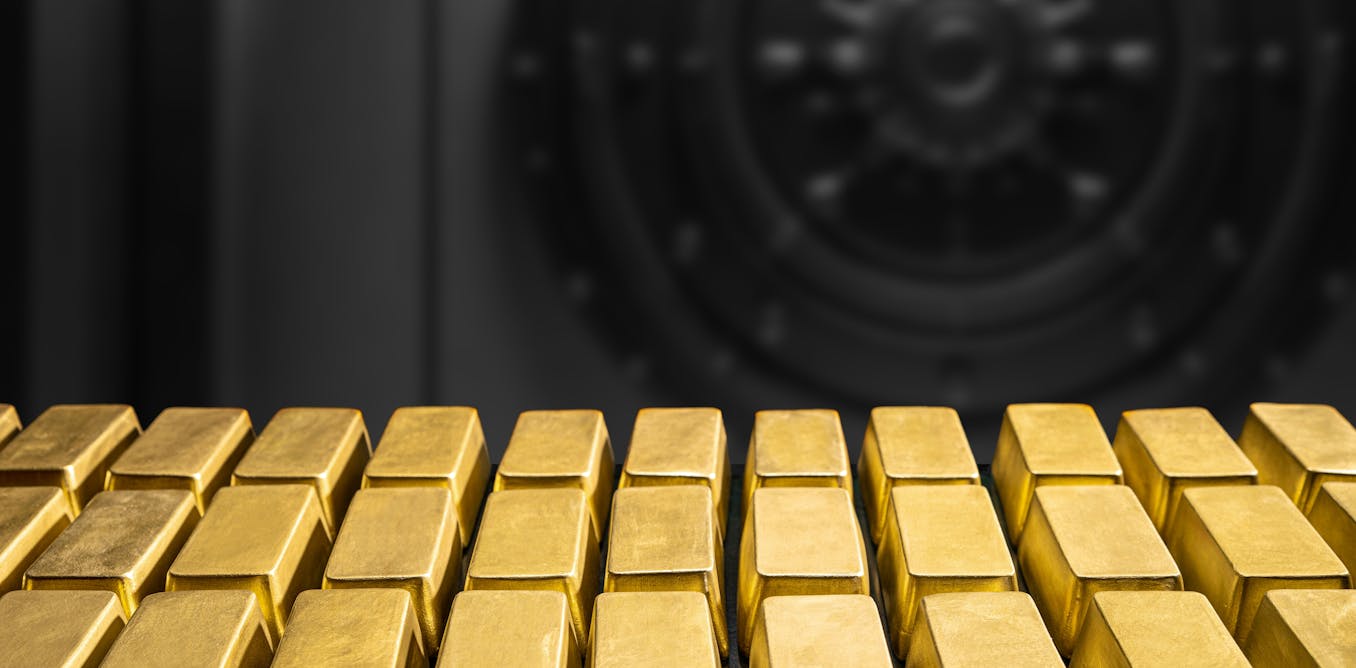
The price of gold reached a historic high in April and remains close to that value. Conventional investing wisdom puts gold as a “safe-haven” asset – one that investors move towards in times of crises as they desert higher-risk assets such as stocks. But in August, the S&P 500 stock index also hit a record high and, like gold, it too remains close to this value.
Historically, those who follow these markets would have expected gold and stock prices to move in opposite directions. This typically produced the “hedging” effect of gold – it would offset losses (and gains) from stocks.
But while “safe” gold and “risky” stocks rise at the same time, the value of gold as a more secure bet in times of strife could be diminishing.
Looking at the price of gold historically shows that it rose in response to the oil price shocks of the 1970s as the global economy fell towards recession. It fell during the late 1990s as stock markets boomed, and as the global economy recovered after 2009.
But since this point, it has shown a trajectory largely in common with stocks. New research I was involved in looked at several reasons these traditionally opposing forces have been converging – and causing gold’s safe-haven effect to fade.
Right now, the global economy is emerging from a period of high inflation and high interest rates. Central banks are reducing interest rates (with more cuts expected), which will encourage household spending and business investment.
Economic growth figures are generally trending upwards, as are corporate earnings. And there is positive sentiment within economies about the potential of AI and its role in growth and productivity. Together, these factors explain the rise in stock markets.
But geopolitical risks, especially involving Russia’s invasion of Ukraine and tensions in the Middle East (specifically Iran and attacks by Houthis in the Red Sea) are causing concern for stocks and the wider economy. Both can have significant effects on major international commodities (such as oil and food prices).
And there is risk too from US president Donald Trump’s trade policies. This is especially true given his unpredictability, with tariffs increased and then paused before being reinstated at different levels to those previously announced.
Both these hostilities and Trump’s trade policies create risk and uncertainty within the international economy. This would explain why investors might consider buying gold – making it more valuable.
But this does not fully explain why it is so much in demand and trading close to its all-time high. To understand this, we need to look a bit further back.
Rising demand
After the dotcom crash in the early 2000s, commodities like gold began to be treated (and traded) like other financial assets. Key in this was the development of exchange-traded funds (ETFs), with the first gold ETF launched in 2004. These allow investors to essentially buy a share in gold.
Since then, the number of gold ETFs has risen dramatically, especially after the global financial crisis. Now gold may be traded like any other asset and can become a staple of investment portfolios. Demand for these funds has been surging recently.
On top of this, the US dollar’s status as the world’s currency is under threat. Currently, it acts as a reserve currency for central banks and the vehicle for trade and international payments, including for major commodities. But some countries have increasingly questioned this status quo, considering whether they should trade commodities like oil in their own currencies.

James.Pintar/Shutterstock
Trump, and the uncertainty he causes, only makes these calls grow louder. As such, these doubts about the status of the dollar have led central banks to buy more gold as an alternative reserve asset.
Since the end of the global financial crisis in 2009 and especially for the past ten years, gold has broadly followed the same path as stocks. While there will always be deviations, this effectively means an end of gold as a safe-haven hedge against stock price falls.
Gold is now firmly established as another investment asset, along with stocks, bonds and other commodities. This means that these days, its investment role is as part of a diversified portfolio and not as a hedge.
But that’s not to say that gold has lost its appeal. Its limited supply and desirability for both jewellery and manufacturing are rare and valuable attributes. And with its intrinsic worth recognised all over the world, gold is likely to remain in demand.
The price of gold reached a historic high in April and remains close to that value. Conventional investing wisdom puts gold as a “safe-haven” asset – one that investors move towards in times of crises as they desert higher-risk assets such as stocks. But in August, the S&P 500 stock index also hit a record high and, like gold, it too remains close to this value.
Historically, those who follow these markets would have expected gold and stock prices to move in opposite directions. This typically produced the “hedging” effect of gold – it would offset losses (and gains) from stocks.
But while “safe” gold and “risky” stocks rise at the same time, the value of gold as a more secure bet in times of strife could be diminishing.
Looking at the price of gold historically shows that it rose in response to the oil price shocks of the 1970s as the global economy fell towards recession. It fell during the late 1990s as stock markets boomed, and as the global economy recovered after 2009.
But since this point, it has shown a trajectory largely in common with stocks. New research I was involved in looked at several reasons these traditionally opposing forces have been converging – and causing gold’s safe-haven effect to fade.
Right now, the global economy is emerging from a period of high inflation and high interest rates. Central banks are reducing interest rates (with more cuts expected), which will encourage household spending and business investment.
Economic growth figures are generally trending upwards, as are corporate earnings. And there is positive sentiment within economies about the potential of AI and its role in growth and productivity. Together, these factors explain the rise in stock markets.
But geopolitical risks, especially involving Russia’s invasion of Ukraine and tensions in the Middle East (specifically Iran and attacks by Houthis in the Red Sea) are causing concern for stocks and the wider economy. Both can have significant effects on major international commodities (such as oil and food prices).
And there is risk too from US president Donald Trump’s trade policies. This is especially true given his unpredictability, with tariffs increased and then paused before being reinstated at different levels to those previously announced.
Both these hostilities and Trump’s trade policies create risk and uncertainty within the international economy. This would explain why investors might consider buying gold – making it more valuable.
But this does not fully explain why it is so much in demand and trading close to its all-time high. To understand this, we need to look a bit further back.
Rising demand
After the dotcom crash in the early 2000s, commodities like gold began to be treated (and traded) like other financial assets. Key in this was the development of exchange-traded funds (ETFs), with the first gold ETF launched in 2004. These allow investors to essentially buy a share in gold.
Since then, the number of gold ETFs has risen dramatically, especially after the global financial crisis. Now gold may be traded like any other asset and can become a staple of investment portfolios. Demand for these funds has been surging recently.
On top of this, the US dollar’s status as the world’s currency is under threat. Currently, it acts as a reserve currency for central banks and the vehicle for trade and international payments, including for major commodities. But some countries have increasingly questioned this status quo, considering whether they should trade commodities like oil in their own currencies.
James.Pintar/Shutterstock
Trump, and the uncertainty he causes, only makes these calls grow louder. As such, these doubts about the status of the dollar have led central banks to buy more gold as an alternative reserve asset.
Since the end of the global financial crisis in 2009 and especially for the past ten years, gold has broadly followed the same path as stocks. While there will always be deviations, this effectively means an end of gold as a safe-haven hedge against stock price falls.
Gold is now firmly established as another investment asset, along with stocks, bonds and other commodities. This means that these days, its investment role is as part of a diversified portfolio and not as a hedge.
But that’s not to say that gold has lost its appeal. Its limited supply and desirability for both jewellery and manufacturing are rare and valuable attributes. And with its intrinsic worth recognised all over the world, gold is likely to remain in demand.