



Most of the ordinary matter in the universe is hydrogen. But surprisingly, less than 20% of this hydrogen sits inside galaxies. The rest lies in the vast spaces between them – the so-called intergalactic medium.
This cosmic reservoir is thought to fuel the birth of new stars, as gas slowly falls into galaxies over billions of years. Yet much of that material doesn’t stay put: supernova explosions and powerful outflows from supermassive black holes can fling gas back out into intergalactic space.
The push-and-pull between inflows and outflows is central to understanding how galaxies grow and change over cosmic time. Probing this balance is one of the aims of the WALLABY survey, carried out using the Australian SKA Pathfinder (ASKAP) telescope at Inyarrimanha Ilgari Bundara, CSIRO’s Murchison Radio-astronomy Observatory in Western Australia.
A new discovery from WALLABY, published today in Monthly Notices of the Royal Astronomical Society, sheds new light on the cosmic cycle of matter into, through and out of galaxies.
What is WALLABY?
Despite its name, WALLABY isn’t about animals. It’s a somewhat contrived acronym – Widefield ASKAP L-band Legacy All-sky Blind surveY – for a large survey of neutral hydrogen (the atomic form of hydrogen) across nearly half the southern sky. The ASKAP telescope is sensitive enough to detect hydrogen in and around galaxies up to a billion light years away.

ICRAR
Because it’s a “blind” survey, WALLABY doesn’t target known galaxies. Instead, it scans huge patches of sky – each night covering an area about 150 times the size of the full Moon.
A galactic bridge
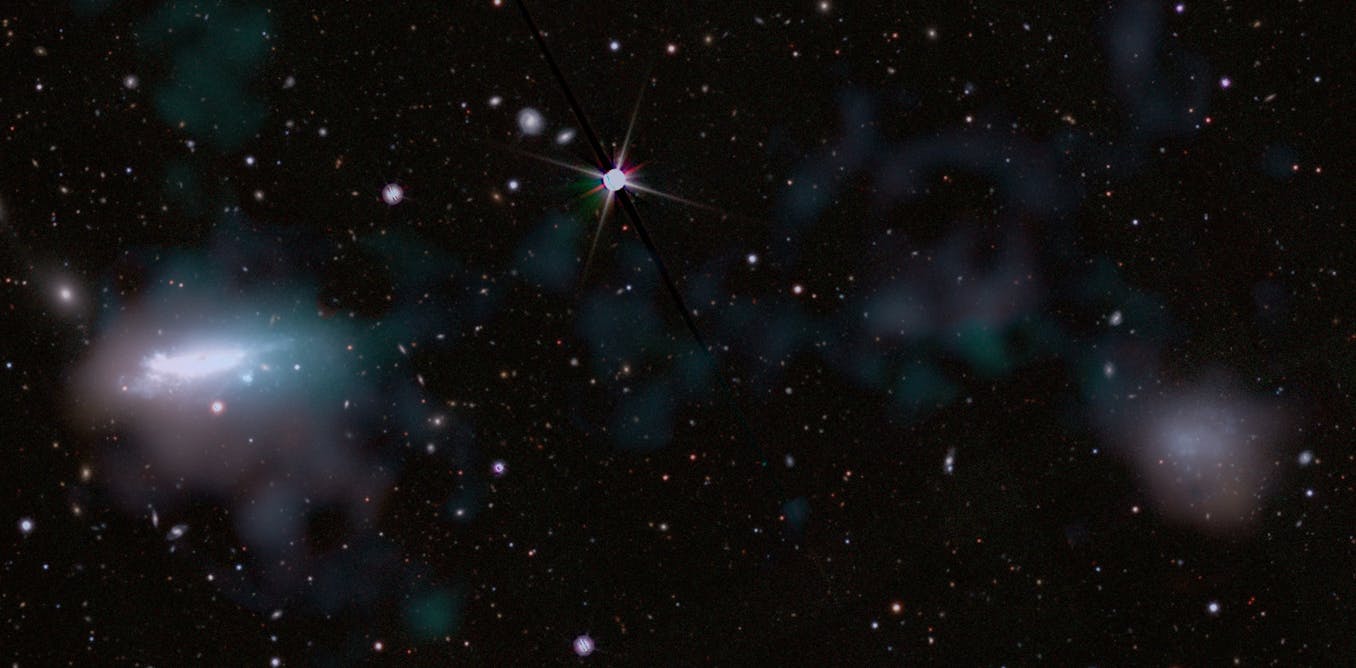
We then use automated algorithms to search for signs of hydrogen in the resulting data. One such search revealed an unusual gas bridge linking two otherwise unremarkable galaxies on the outskirts of the Virgo cluster, in the constellation Virgo. The bridge, at least 160,000 light years long, likely formed through tidal interactions between two dwarf galaxies known as NGC 4532 and DDO 137.

ICRAR and D.Lang (Perimeter Institute)
These tides are the cosmic equivalent of Earth’s ocean tides, but on a vastly larger scale and made of hydrogen rather than water. Gas pulled from the galaxies now stretches between them, filling the surrounding intergalactic space.
Such bridges are hard to detect because they contain few stars. But we have a local example: the Large and Small Magellanic Clouds, two dwarf galaxies orbiting the Milky Way, are joined by a 70,000-light-year-long gas bridge.
An extraordinary tail
The newly discovered bridge also helps explain a long-standing puzzle: an enormous gas tail streaming away from the dwarf galaxies NGC 4532 and DDO 137, first detected more than 30 years ago with the Arecibo telescope. This tail is ten times longer than the bridge and is the largest ever observed from a galaxy system.
New observations suggest that while tidal forces created the bridge and the envelope of gas around the galaxies, the spectacular tail was produced by another process.
As the pair of galaxies plunges into the Virgo cluster, they encounter extremely hot, thin gas that fills the cluster. The galaxies’ motion through this medium produces ram pressure – much like the resistance felt when cycling into a strong headwind – which strips gas from them and sweeps it out behind.
Remarkably, the gas density required for this effect is only around ten atoms per cubic metre, a value consistent with new measurements from the eROSITA X-ray telescope. Thanks to the galaxies’ high infall speed – more than 800 kilometres per second – this sparse medium is enough to create the vast tail.
The bigger picture
These two galaxies are just a fraction of the 200,000 WALLABY expects to detect by the end of its survey. Each discovery adds to our picture of how gas flows in and out of galaxies, enriching the intergalactic medium and shaping galactic evolution.
Together, they will help astronomers untangle the so-called baryonic cycle – the continuous recycling of matter between galaxies and the space around them.
Most of the ordinary matter in the universe is hydrogen. But surprisingly, less than 20% of this hydrogen sits inside galaxies. The rest lies in the vast spaces between them – the so-called intergalactic medium.
This cosmic reservoir is thought to fuel the birth of new stars, as gas slowly falls into galaxies over billions of years. Yet much of that material doesn’t stay put: supernova explosions and powerful outflows from supermassive black holes can fling gas back out into intergalactic space.
The push-and-pull between inflows and outflows is central to understanding how galaxies grow and change over cosmic time. Probing this balance is one of the aims of the WALLABY survey, carried out using the Australian SKA Pathfinder (ASKAP) telescope at Inyarrimanha Ilgari Bundara, CSIRO’s Murchison Radio-astronomy Observatory in Western Australia.
A new discovery from WALLABY, published today in Monthly Notices of the Royal Astronomical Society, sheds new light on the cosmic cycle of matter into, through and out of galaxies.
What is WALLABY?
Despite its name, WALLABY isn’t about animals. It’s a somewhat contrived acronym – Widefield ASKAP L-band Legacy All-sky Blind surveY – for a large survey of neutral hydrogen (the atomic form of hydrogen) across nearly half the southern sky. The ASKAP telescope is sensitive enough to detect hydrogen in and around galaxies up to a billion light years away.
ICRAR
Because it’s a “blind” survey, WALLABY doesn’t target known galaxies. Instead, it scans huge patches of sky – each night covering an area about 150 times the size of the full Moon.
A galactic bridge
We then use automated algorithms to search for signs of hydrogen in the resulting data. One such search revealed an unusual gas bridge linking two otherwise unremarkable galaxies on the outskirts of the Virgo cluster, in the constellation Virgo. The bridge, at least 160,000 light years long, likely formed through tidal interactions between two dwarf galaxies known as NGC 4532 and DDO 137.
ICRAR and D.Lang (Perimeter Institute)
These tides are the cosmic equivalent of Earth’s ocean tides, but on a vastly larger scale and made of hydrogen rather than water. Gas pulled from the galaxies now stretches between them, filling the surrounding intergalactic space.
Such bridges are hard to detect because they contain few stars. But we have a local example: the Large and Small Magellanic Clouds, two dwarf galaxies orbiting the Milky Way, are joined by a 70,000-light-year-long gas bridge.
An extraordinary tail
The newly discovered bridge also helps explain a long-standing puzzle: an enormous gas tail streaming away from the dwarf galaxies NGC 4532 and DDO 137, first detected more than 30 years ago with the Arecibo telescope. This tail is ten times longer than the bridge and is the largest ever observed from a galaxy system.
New observations suggest that while tidal forces created the bridge and the envelope of gas around the galaxies, the spectacular tail was produced by another process.
As the pair of galaxies plunges into the Virgo cluster, they encounter extremely hot, thin gas that fills the cluster. The galaxies’ motion through this medium produces ram pressure – much like the resistance felt when cycling into a strong headwind – which strips gas from them and sweeps it out behind.
Remarkably, the gas density required for this effect is only around ten atoms per cubic metre, a value consistent with new measurements from the eROSITA X-ray telescope. Thanks to the galaxies’ high infall speed – more than 800 kilometres per second – this sparse medium is enough to create the vast tail.
The bigger picture
These two galaxies are just a fraction of the 200,000 WALLABY expects to detect by the end of its survey. Each discovery adds to our picture of how gas flows in and out of galaxies, enriching the intergalactic medium and shaping galactic evolution.
Together, they will help astronomers untangle the so-called baryonic cycle – the continuous recycling of matter between galaxies and the space around them.