


The U.K government has announced that it will advance long-delayed regulations on commodities linked to deforestation. On June 23, the Department for Environment, Food and Rural Affairs (DEFRA) issued a press release promising to “take forward new rules” that will force companies in Great Britain to carry out due diligence on the products they sell.
“Under the proposals UK businesses who trade in commodities sourced from rainforests such as soy, palm oil, cocoa and rubber will need to check that their supply chains are not contributing to illegal deforestation,” it said.
The rules have been anticipated since the passage of the U.K.’s Environment Act in 2021. “Schedule 17” of the Act established a legal basis for strict rules covering forest risk commodities, but the U.K. government has yet to issue those rules or submit them to Parliament. The slow implementation of Schedule 17 has drawn the ire of environmental groups and their allies.
In a press release, U.K.-based NGO Forest Coalition welcomed the latest announcement.
“In our view the delay has been unacceptable because the U.K. imports deforestation-tainted commodities,” said Cassie Dummett, the group’s coordinator, in a phone interview with Mongabay. “That means members of the public are buying deforestation in the food they buy, unwittingly.”
The U.K. government said the regulation will closely mirror the European Union’s Deforestation Regulation (EUDR), which, despite repeated delays, is set to take effect at the end of 2026. Both rules will cover a similar set of commodities, including cattle, cocoa, palm oil, rubber and soy. By aligning the two regulations, the U.K. will be able to avoid thorny trade issues with the bloc. It will also prevent complications for Northern Ireland, which remains part of the EU’s single market.
“The aim is that the information GB businesses must hold will be broadly the same as what is needed for a due diligence statement when exporting to the EU or moving goods to Northern Ireland under the EUDR,” the U.K. government wrote in a policy brief that accompanied the announcement.
At least initially, the two sets of rules will diverge on one critical point. The U.K.’s regulation only covers commodities linked to deforestation if that deforestation is illegal in the exporting country. The EUDR, on the other hand, applies to all forms of deforestation.
In practice, this means that if an exporting country legalizes deforestation, it can export products linked to deforestation into the U.K. but not the EU. The U.K. government has stated its intention to close that gap, but it won’t happen under the new rules.
“That requires legislation separate from these anticipated regulations,” Dummett said. “We want to see movement on that as soon as possible.”
The agency said it expects to submit updated regulations to parliament for a vote at some point in 2027.
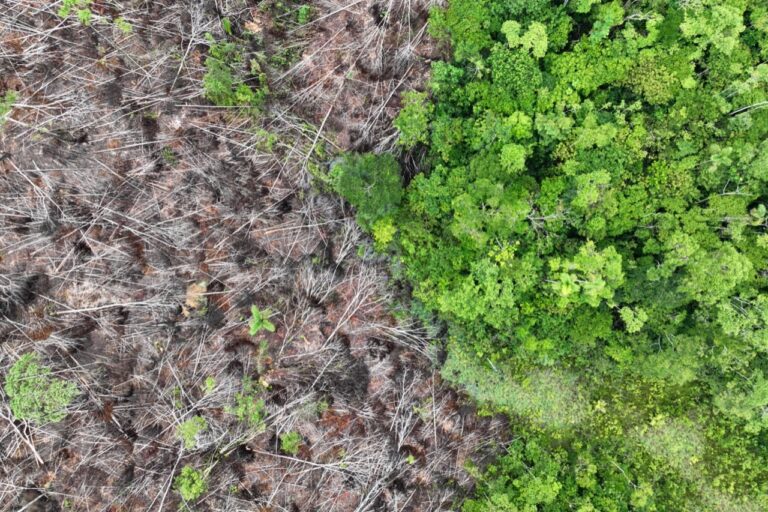
Banner image: Deforestation for oil palm in the Amazon rainforest. Image by Rhett A. Butler / Mongabay.
Credits

The U.K government has announced that it will advance long-delayed regulations on commodities linked to deforestation. On June 23, the Department for Environment, Food and Rural Affairs (DEFRA) issued a press release promising to “take forward new rules” that will force companies in Great Britain to carry out due diligence on the products they sell.
“Under the proposals UK businesses who trade in commodities sourced from rainforests such as soy, palm oil, cocoa and rubber will need to check that their supply chains are not contributing to illegal deforestation,” it said.
The rules have been anticipated since the passage of the U.K.’s Environment Act in 2021. “Schedule 17” of the Act established a legal basis for strict rules covering forest risk commodities, but the U.K. government has yet to issue those rules or submit them to Parliament. The slow implementation of Schedule 17 has drawn the ire of environmental groups and their allies.
In a press release, U.K.-based NGO Forest Coalition welcomed the latest announcement.
“In our view the delay has been unacceptable because the U.K. imports deforestation-tainted commodities,” said Cassie Dummett, the group’s coordinator, in a phone interview with Mongabay. “That means members of the public are buying deforestation in the food they buy, unwittingly.”
The U.K. government said the regulation will closely mirror the European Union’s Deforestation Regulation (EUDR), which, despite repeated delays, is set to take effect at the end of 2026. Both rules will cover a similar set of commodities, including cattle, cocoa, palm oil, rubber and soy. By aligning the two regulations, the U.K. will be able to avoid thorny trade issues with the bloc. It will also prevent complications for Northern Ireland, which remains part of the EU’s single market.
“The aim is that the information GB businesses must hold will be broadly the same as what is needed for a due diligence statement when exporting to the EU or moving goods to Northern Ireland under the EUDR,” the U.K. government wrote in a policy brief that accompanied the announcement.
At least initially, the two sets of rules will diverge on one critical point. The U.K.’s regulation only covers commodities linked to deforestation if that deforestation is illegal in the exporting country. The EUDR, on the other hand, applies to all forms of deforestation.
In practice, this means that if an exporting country legalizes deforestation, it can export products linked to deforestation into the U.K. but not the EU. The U.K. government has stated its intention to close that gap, but it won’t happen under the new rules.
“That requires legislation separate from these anticipated regulations,” Dummett said. “We want to see movement on that as soon as possible.”
The agency said it expects to submit updated regulations to parliament for a vote at some point in 2027.
Banner image: Deforestation for oil palm in the Amazon rainforest. Image by Rhett A. Butler / Mongabay.
Credits