



World
/
August 18, 2025
No one can trust the United States when a fickle man-child controls its foreign policy.
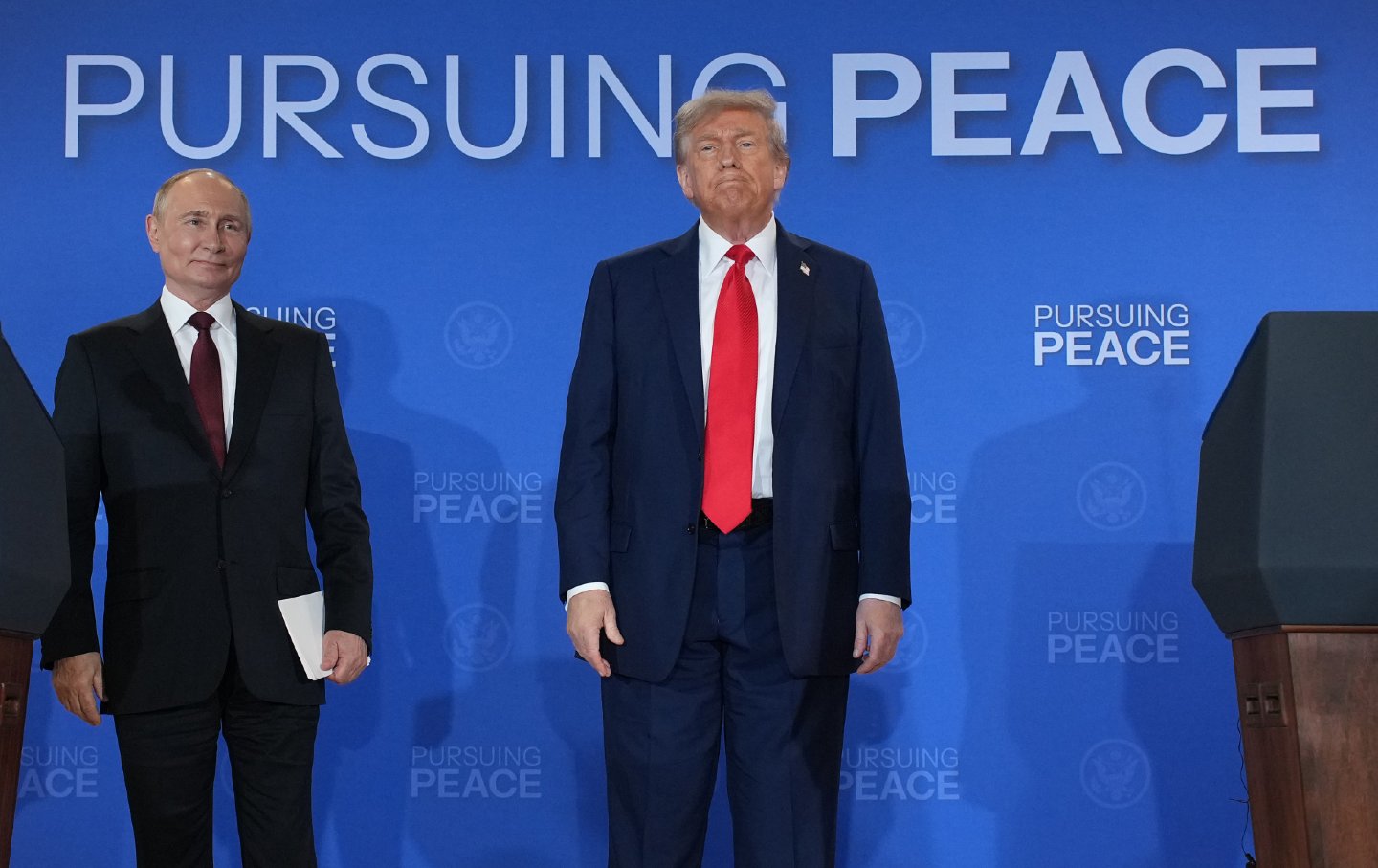
US President Donald Trump and Russian President Vladimir Putin leave at the conclusion of a press conference at Joint Base Elmendorf-Richardson on August 15, 2025, in Anchorage, Alaska.
(Andrew Harnik / Getty Images)
When Donald Trump spoke to an adoring crowd at the Republican National Convention in 2016, he distilled the essence of his autocratic politics into a self-aggrandizing phrase: “I alone can fix it.”
Trump has an inordinate faith in his abilities as a problem solver and dealmaker. His cult of personality is based on the fantasy of his omni-competence, and this shared delusion has effectively become the governing ideology of the Republican Party. Again and again, the president has claimed that, unlike previous US political leaders whom he dubs “stupid,” he can quickly make good deals with foreign powers.
In 2024, Trump repeatedly asserted that he could end the Russia-Ukraine war in 24 hours. He now acknowledges that this was an “exaggeration.” But this rare concession to reality hasn’t shaken his confidence. Trump’s bizarre meeting on Friday with Russian President Vladimir Putin in a hastily organized summit in Alaska is the latest example of Trump deploying his dealmaking skills (which are foundational to his personal brand) to solve an intractable problem. Unfortunately, Trump’s own erratic behavior during the Alaska summit made clear why he can’t make peace—and indeed why he’s making the world a much more dangerous place.
Current Issue

Of course, Trump is not the first president to have an outsize sense of his own personal abilities, especially in the realm of foreign policy. Since the start of the atomic age with the bombing of Hiroshima, the United States has been a “thermonuclear monarchy” (to borrow a useful phrase coined by the scholar Elaine Scarry), one where the president is vested with the godlike power to unleash weapons that could end all human life. Further, the imperial presidency that became entrenched during the Cold War has given the president unusual freedom in foreign policy, including the ability to launch wars by fiat—and in defiance of the Constitution that reserves that power for Congress. But the same national security state that elevated the presidency to dominance also created a complex, sprawling bureaucracy that maintains guardrails, making it difficult for the whims of any individual to determine foreign policy.
In his first term, Trump often felt hemmed in by this bureaucracy, which he came to see as a “deep state” conspiracy against his presidency. In his second term, Trump has dismantled much of the national security bureaucracy that advises the president and instead relies on an inner coterie of loyalists. As documented in an important essay in The Atlantic, Trump “has pushed away the help of career experts, and major decisions—the handling of the war in Gaza, for example, and negotiations over Ukraine—are now made by a tiny core group of loyal advisers, including Vice President J.D. Vance, Secretary of State Marco Rubio, Chief of Staff Susie WiIes, and one or two others.”
This decision to shunt aside the national security establishment isn’t itself objectionable. After all, the permanent security bureaucracy has often pushed disastrous decisions, such as the Vietnam War; the alliances with Middle Eastern autocracies, which have led to numerous wars; and the post–Cold War expansion of NATO, which is a major cause of the current Russia-Ukraine war. Conversely, some of the major achievements of US foreign policy have come from presidents willing to defy the establishment: John F. Kennedy using backchannel diplomacy to end the Cuban missile crisis, Richard Nixon opening relations with China, and Barack Obama making a nuclear deal with Iran all come to mind.
Unfortunately, Trump has none of the diplomatic skills of a Kennedy, Nixon, or Obama. Rather, foreign policy is a stage where all the vices of Trump’s malignant personality—his narcissism, his intellectual incuriosity, his fickleness, his indulgence in conspiratorial fantasies, his love of flattery, his pleasure in bullying—display themselves for all the world to see.
The tragedy of the current moment desperately requires a skilled US president who can bring wars to an end. The Russia-Ukraine war, in particular, is a catastrophe that demands a quick resolution. A Gallup poll released earlier this month shows that 69 percent of Ukrainians want a negotiated end to the war as soon as possible, while only 24 percent support fighting until victory.
To understand the desire of Ukrainians for peace, you just need to look at population statistics. The population of Ukraine peaked in 1992 at roughly 52 million and then went into a decline common in post-Soviet societies. This decline intensified with the 2022 Russian invasion, which led to a massive flight of refugees, the death of countless soldiers, and a decline in fertility. Ukraine now has roughly 32 million people, a population lower than at any point since 1937. In the words of University of Chicago political scientist John Mearsheimer, Ukraine is experiencing a “demographic death spiral.”
Ukraine’s population decline makes it harder to continue its fight, especially since Russia, with its population of 143 million, can draw on a much larger pool of potential soldiers. Not surprisingly, the Ukraine military is facing a conscription crisis and is fielding an army where the average soldier is at least 40 years old. But this military crisis speaks to a larger existential question: What is the point of fighting to save the Ukrainian nation in a war that is rapidly leading to many fewer Ukrainians? This is a classic case where you can save the village only by destroying the village, a futile exercise.
Unfortunately, the political elites of Europe and Ukraine (along with many of their counterparts in the United States) seem intent on ignoring the wishes of the Ukrainian people. These elites are unwilling to give up the notion that the fortunes of the battlefield will turn against Russia. Given this grim situation, it would be useful to have a US president who bucks the national security establishment and pushes for a negotiated end to the war.
Trump occasionally sounds like he’s interested in real diplomacy with Russia, and the political establishment sometimes responds with absurd claims that Trump is Putin’s “puppet” or a long-standing Russian asset (a wild notion expounded at great length by Jonathan Chait in New York magazine).
In truth, Trump is neither a puppet nor a peacemaker. He’s a vainglorious egotist out of his depth. He loves being praised and having his favorite conspiracy theories vindicated, and so he basked in Putin’s assertion that the 2020 US presidential election was stolen. But Trump also delights in being seen as a tough guy, so he often supports hawkish measures against Russia. The effect is a foreign policy of mixed messages, which creates confusion and distrust. This muddled policy makes more wars likely, since failure to communicate can easily lead to one side overstepping what the other side sees as a red line.
Popular
“swipe left below to view more authors”Swipe →
The Atlantic reports on one example of Trump’s centralized decision-making subverting traditional foreign policy:
Some current and former officials fear the setup may also mean inadequate vetting of questionable ideas, such as Trump’s announcement earlier this month that he had repositioned two nuclear submarines in response to bellicose remarks by former Russian President Dmitry Medvedev, a Putin ally. It caught many in the Pentagon by surprise; neither the White House nor the military typically publicly discusses submarine movements. Even after the fact, some Pentagon officials said they weren’t sure whether the submarines had already been scheduled to move or not.
To achieve strategic deterrence, the Navy’s ballistic-missile fleet relies on stealth. “That’s the whole fucking point of submarines. You don’t know where they are,” one defense official explained.
During the summit, Trump quickly shifted from being bellicose to being conciliatory. Before the summit, Trump warned that if Putin did not agree to a ceasefire, “There will be very severe consequences.” But as The Wall Street Journal notes, Trump quickly and inexplicably shifted his tone:
Hours after meeting Putin, however, he dropped his demand in a post on his Truth Social platform, in which he argued in favor of going straight to negotiations for a full peace agreement following his discussions with the leaders of Russia, Ukraine and other European nations…. The move echoes Putin’s preferred approach and would allow the fighting to continue until a deal is reached—something Ukraine has argued against.
In other words, depending on his mood, Trump is a hawk or a dove. This gives all the other parties—the Russians, the Ukrainians, the Europeans—little reason to trust him. This means his diplomacy will at best be ineffectual and at worst engender even more wars. It’s possible that sheer exhaustion will force Russia and Ukraine to reach a settlement, but if that happens, it will not be due to Trump’s actions. Trump is not the dealmaker that he has spent decades touting himself as being. Rather, he’s a chaos agent who wants to be the center of attention. If the world is a tinderbox, Trump is a foolish child who loves playing with matches.
Take a stand against Trump and support The Nation!
In this moment of crisis, we need a unified, progressive opposition to Donald Trump.
We’re starting to see one take shape in the streets and at ballot boxes across the country: from New York City mayoral candidate Zohran Mamdani’s campaign focused on affordability, to communities protecting their neighbors from ICE, to the senators opposing arms shipments to Israel.
The Democratic Party has an urgent choice to make: Will it embrace a politics that is principled and popular, or will it continue to insist on losing elections with the out-of-touch elites and consultants that got us here?
At The Nation, we know which side we’re on. Every day, we make the case for a more democratic and equal world by championing progressive leaders, lifting up movements fighting for justice, and exposing the oligarchs and corporations profiting at the expense of us all. Our independent journalism informs and empowers progressives across the country and helps bring this politics to new readers ready to join the fight.
We need your help to continue this work. Will you donate to support The Nation’s independent journalism? Every contribution goes to our award-winning reporting, analysis, and commentary.
Thank you for helping us take on Trump and build the just society we know is possible.
Sincerely,
Bhaskar Sunkara
President, The Nation
Jeet Heer
Jeet Heer is a national affairs correspondent for The Nation and host of the weekly Nation podcast, The Time of Monsters. He also pens the monthly column “Morbid Symptoms.” The author of In Love with Art: Francoise Mouly’s Adventures in Comics with Art Spiegelman (2013) and Sweet Lechery: Reviews, Essays and Profiles (2014), Heer has written for numerous publications, including The New Yorker, The Paris Review, Virginia Quarterly Review, The American Prospect, The Guardian, The New Republic, and The Boston Globe.
World
/
August 18, 2025
No one can trust the United States when a fickle man-child controls its foreign policy.
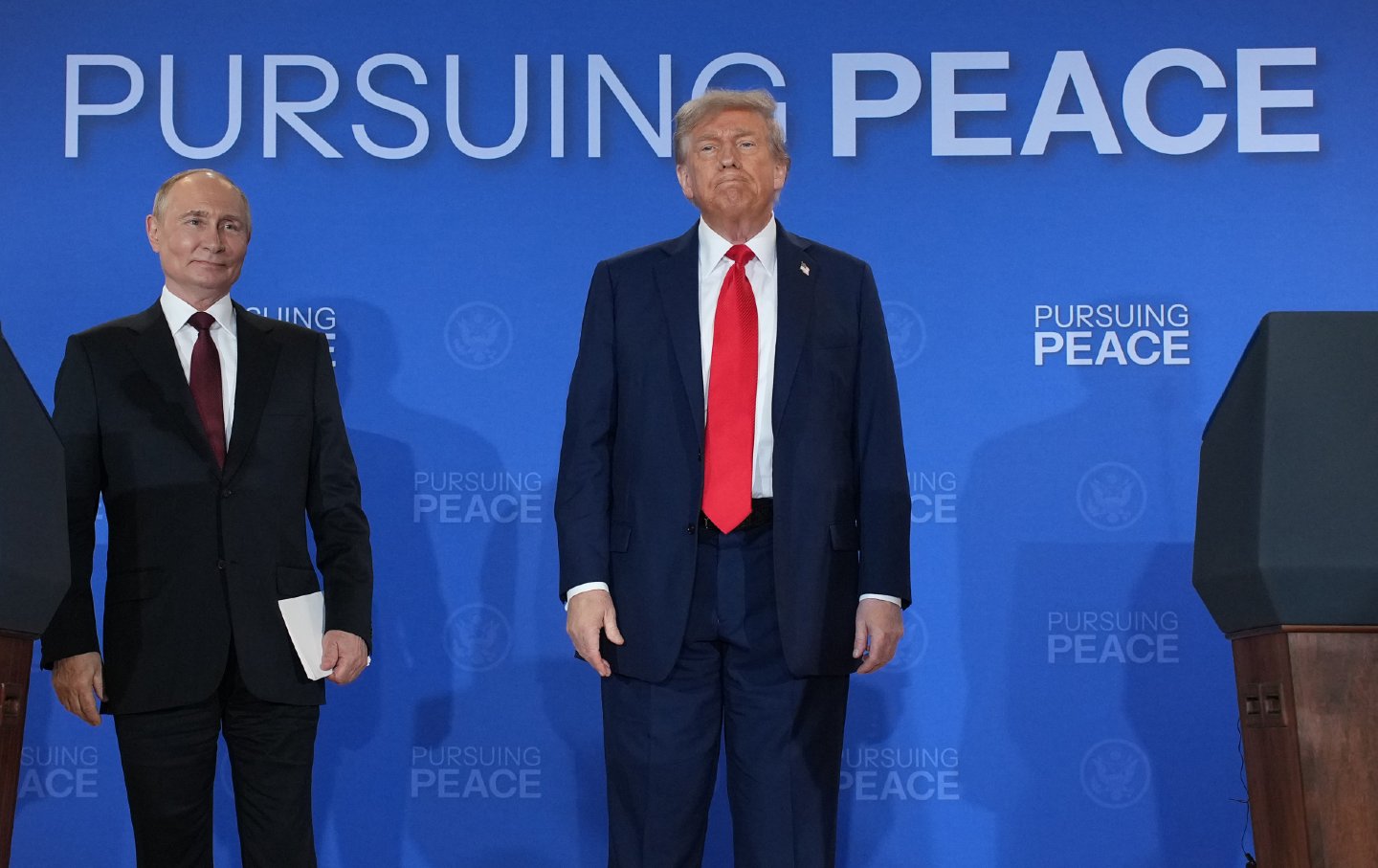
US President Donald Trump and Russian President Vladimir Putin leave at the conclusion of a press conference at Joint Base Elmendorf-Richardson on August 15, 2025, in Anchorage, Alaska.
(Andrew Harnik / Getty Images)
When Donald Trump spoke to an adoring crowd at the Republican National Convention in 2016, he distilled the essence of his autocratic politics into a self-aggrandizing phrase: “I alone can fix it.”
Trump has an inordinate faith in his abilities as a problem solver and dealmaker. His cult of personality is based on the fantasy of his omni-competence, and this shared delusion has effectively become the governing ideology of the Republican Party. Again and again, the president has claimed that, unlike previous US political leaders whom he dubs “stupid,” he can quickly make good deals with foreign powers.
In 2024, Trump repeatedly asserted that he could end the Russia-Ukraine war in 24 hours. He now acknowledges that this was an “exaggeration.” But this rare concession to reality hasn’t shaken his confidence. Trump’s bizarre meeting on Friday with Russian President Vladimir Putin in a hastily organized summit in Alaska is the latest example of Trump deploying his dealmaking skills (which are foundational to his personal brand) to solve an intractable problem. Unfortunately, Trump’s own erratic behavior during the Alaska summit made clear why he can’t make peace—and indeed why he’s making the world a much more dangerous place.
Current Issue
Of course, Trump is not the first president to have an outsize sense of his own personal abilities, especially in the realm of foreign policy. Since the start of the atomic age with the bombing of Hiroshima, the United States has been a “thermonuclear monarchy” (to borrow a useful phrase coined by the scholar Elaine Scarry), one where the president is vested with the godlike power to unleash weapons that could end all human life. Further, the imperial presidency that became entrenched during the Cold War has given the president unusual freedom in foreign policy, including the ability to launch wars by fiat—and in defiance of the Constitution that reserves that power for Congress. But the same national security state that elevated the presidency to dominance also created a complex, sprawling bureaucracy that maintains guardrails, making it difficult for the whims of any individual to determine foreign policy.
In his first term, Trump often felt hemmed in by this bureaucracy, which he came to see as a “deep state” conspiracy against his presidency. In his second term, Trump has dismantled much of the national security bureaucracy that advises the president and instead relies on an inner coterie of loyalists. As documented in an important essay in The Atlantic, Trump “has pushed away the help of career experts, and major decisions—the handling of the war in Gaza, for example, and negotiations over Ukraine—are now made by a tiny core group of loyal advisers, including Vice President J.D. Vance, Secretary of State Marco Rubio, Chief of Staff Susie WiIes, and one or two others.”
This decision to shunt aside the national security establishment isn’t itself objectionable. After all, the permanent security bureaucracy has often pushed disastrous decisions, such as the Vietnam War; the alliances with Middle Eastern autocracies, which have led to numerous wars; and the post–Cold War expansion of NATO, which is a major cause of the current Russia-Ukraine war. Conversely, some of the major achievements of US foreign policy have come from presidents willing to defy the establishment: John F. Kennedy using backchannel diplomacy to end the Cuban missile crisis, Richard Nixon opening relations with China, and Barack Obama making a nuclear deal with Iran all come to mind.
Unfortunately, Trump has none of the diplomatic skills of a Kennedy, Nixon, or Obama. Rather, foreign policy is a stage where all the vices of Trump’s malignant personality—his narcissism, his intellectual incuriosity, his fickleness, his indulgence in conspiratorial fantasies, his love of flattery, his pleasure in bullying—display themselves for all the world to see.
The tragedy of the current moment desperately requires a skilled US president who can bring wars to an end. The Russia-Ukraine war, in particular, is a catastrophe that demands a quick resolution. A Gallup poll released earlier this month shows that 69 percent of Ukrainians want a negotiated end to the war as soon as possible, while only 24 percent support fighting until victory.
To understand the desire of Ukrainians for peace, you just need to look at population statistics. The population of Ukraine peaked in 1992 at roughly 52 million and then went into a decline common in post-Soviet societies. This decline intensified with the 2022 Russian invasion, which led to a massive flight of refugees, the death of countless soldiers, and a decline in fertility. Ukraine now has roughly 32 million people, a population lower than at any point since 1937. In the words of University of Chicago political scientist John Mearsheimer, Ukraine is experiencing a “demographic death spiral.”
Ukraine’s population decline makes it harder to continue its fight, especially since Russia, with its population of 143 million, can draw on a much larger pool of potential soldiers. Not surprisingly, the Ukraine military is facing a conscription crisis and is fielding an army where the average soldier is at least 40 years old. But this military crisis speaks to a larger existential question: What is the point of fighting to save the Ukrainian nation in a war that is rapidly leading to many fewer Ukrainians? This is a classic case where you can save the village only by destroying the village, a futile exercise.
Unfortunately, the political elites of Europe and Ukraine (along with many of their counterparts in the United States) seem intent on ignoring the wishes of the Ukrainian people. These elites are unwilling to give up the notion that the fortunes of the battlefield will turn against Russia. Given this grim situation, it would be useful to have a US president who bucks the national security establishment and pushes for a negotiated end to the war.
Trump occasionally sounds like he’s interested in real diplomacy with Russia, and the political establishment sometimes responds with absurd claims that Trump is Putin’s “puppet” or a long-standing Russian asset (a wild notion expounded at great length by Jonathan Chait in New York magazine).
In truth, Trump is neither a puppet nor a peacemaker. He’s a vainglorious egotist out of his depth. He loves being praised and having his favorite conspiracy theories vindicated, and so he basked in Putin’s assertion that the 2020 US presidential election was stolen. But Trump also delights in being seen as a tough guy, so he often supports hawkish measures against Russia. The effect is a foreign policy of mixed messages, which creates confusion and distrust. This muddled policy makes more wars likely, since failure to communicate can easily lead to one side overstepping what the other side sees as a red line.
Popular
“swipe left below to view more authors”Swipe →
The Atlantic reports on one example of Trump’s centralized decision-making subverting traditional foreign policy:
Some current and former officials fear the setup may also mean inadequate vetting of questionable ideas, such as Trump’s announcement earlier this month that he had repositioned two nuclear submarines in response to bellicose remarks by former Russian President Dmitry Medvedev, a Putin ally. It caught many in the Pentagon by surprise; neither the White House nor the military typically publicly discusses submarine movements. Even after the fact, some Pentagon officials said they weren’t sure whether the submarines had already been scheduled to move or not.
To achieve strategic deterrence, the Navy’s ballistic-missile fleet relies on stealth. “That’s the whole fucking point of submarines. You don’t know where they are,” one defense official explained.
During the summit, Trump quickly shifted from being bellicose to being conciliatory. Before the summit, Trump warned that if Putin did not agree to a ceasefire, “There will be very severe consequences.” But as The Wall Street Journal notes, Trump quickly and inexplicably shifted his tone:
Hours after meeting Putin, however, he dropped his demand in a post on his Truth Social platform, in which he argued in favor of going straight to negotiations for a full peace agreement following his discussions with the leaders of Russia, Ukraine and other European nations…. The move echoes Putin’s preferred approach and would allow the fighting to continue until a deal is reached—something Ukraine has argued against.
In other words, depending on his mood, Trump is a hawk or a dove. This gives all the other parties—the Russians, the Ukrainians, the Europeans—little reason to trust him. This means his diplomacy will at best be ineffectual and at worst engender even more wars. It’s possible that sheer exhaustion will force Russia and Ukraine to reach a settlement, but if that happens, it will not be due to Trump’s actions. Trump is not the dealmaker that he has spent decades touting himself as being. Rather, he’s a chaos agent who wants to be the center of attention. If the world is a tinderbox, Trump is a foolish child who loves playing with matches.
Take a stand against Trump and support The Nation!
In this moment of crisis, we need a unified, progressive opposition to Donald Trump.
We’re starting to see one take shape in the streets and at ballot boxes across the country: from New York City mayoral candidate Zohran Mamdani’s campaign focused on affordability, to communities protecting their neighbors from ICE, to the senators opposing arms shipments to Israel.
The Democratic Party has an urgent choice to make: Will it embrace a politics that is principled and popular, or will it continue to insist on losing elections with the out-of-touch elites and consultants that got us here?
At The Nation, we know which side we’re on. Every day, we make the case for a more democratic and equal world by championing progressive leaders, lifting up movements fighting for justice, and exposing the oligarchs and corporations profiting at the expense of us all. Our independent journalism informs and empowers progressives across the country and helps bring this politics to new readers ready to join the fight.
We need your help to continue this work. Will you donate to support The Nation’s independent journalism? Every contribution goes to our award-winning reporting, analysis, and commentary.
Thank you for helping us take on Trump and build the just society we know is possible.
Sincerely,
Bhaskar Sunkara
President, The Nation
Jeet Heer
Jeet Heer is a national affairs correspondent for The Nation and host of the weekly Nation podcast, The Time of Monsters. He also pens the monthly column “Morbid Symptoms.” The author of In Love with Art: Francoise Mouly’s Adventures in Comics with Art Spiegelman (2013) and Sweet Lechery: Reviews, Essays and Profiles (2014), Heer has written for numerous publications, including The New Yorker, The Paris Review, Virginia Quarterly Review, The American Prospect, The Guardian, The New Republic, and The Boston Globe.