




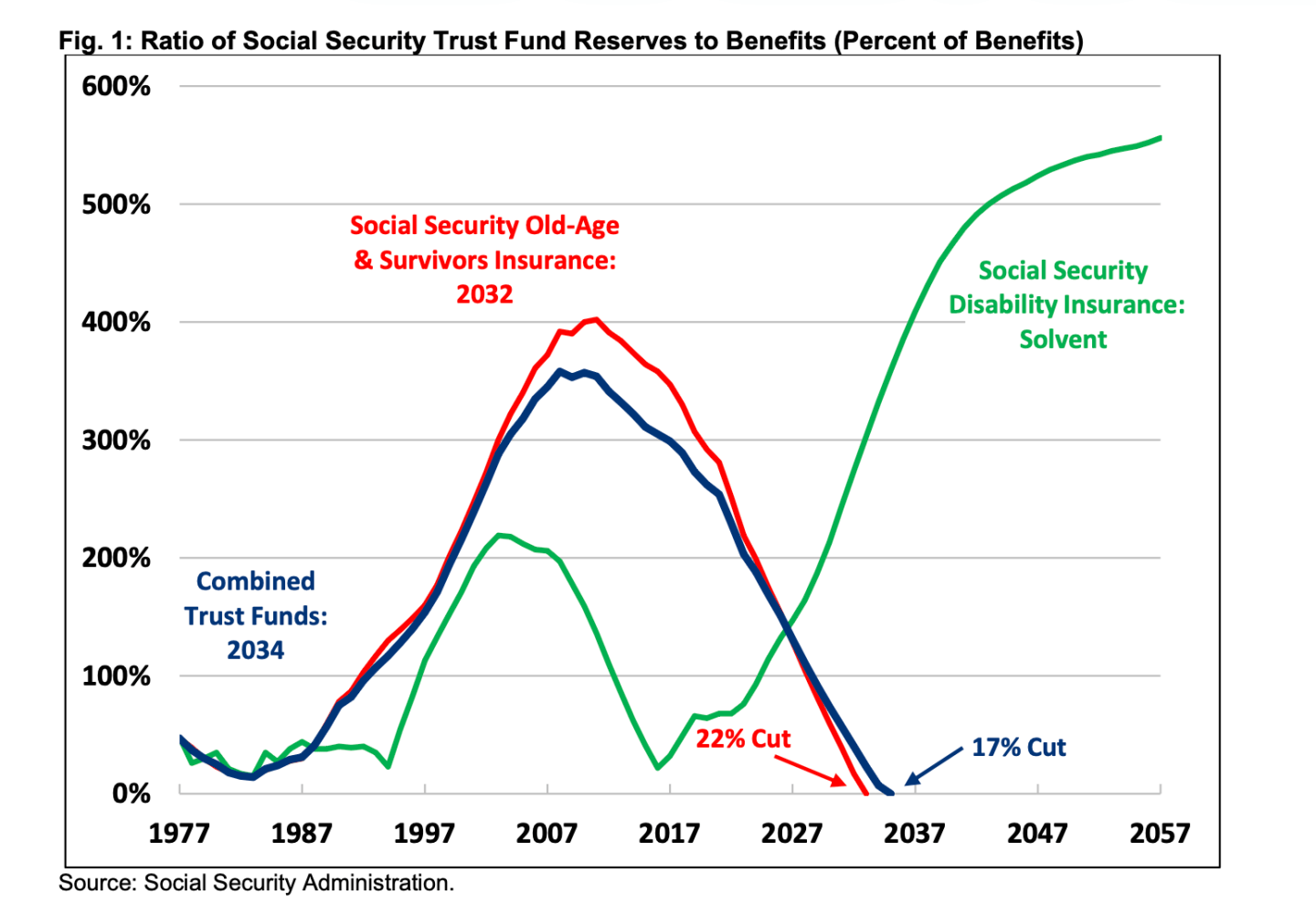
Social Security is hurtling toward a fiscal cliff that, if left unaddressed, will force an automatic 22% benefit cut for tens of millions of retirees, survivors, and their dependents in just six years.
That’s the stark warning from the release last week of the 2026 Social Security Trustees’ Report. A nonpartisan fiscal watchdog, the Committee for a Responsible Federal Budget (CRFB), found the program’s financial imbalance has reached its most severe point in nearly 50 years—and that inaction by lawmakers is making a bad situation measurably worse.
“Social Security is on a collision course toward insolvency,” the CRFB wrote in its analysis. “If policymakers fail to act, they will effectively be supporting a 22% benefit cut for all retirees, survivors, and their dependents in just six years.” The watchdog noted that the program hasn’t been so close to insolvency since 1983, when President Ronald Reagan and Speaker Tip O’Neill famously put partisanship aside to safeguard the program — until now.
The numbers are getting harder to ignore
The Old-Age and Survivors Insurance (OASI) trust fund—the primary fund that pays retirement benefits —is now projected to run dry in 2032, one year sooner than last year’s estimate. If disability insurance reserves are folded in, the theoretically combined trust funds exhaust in 2034, triggering a 17% across-the-board cut.
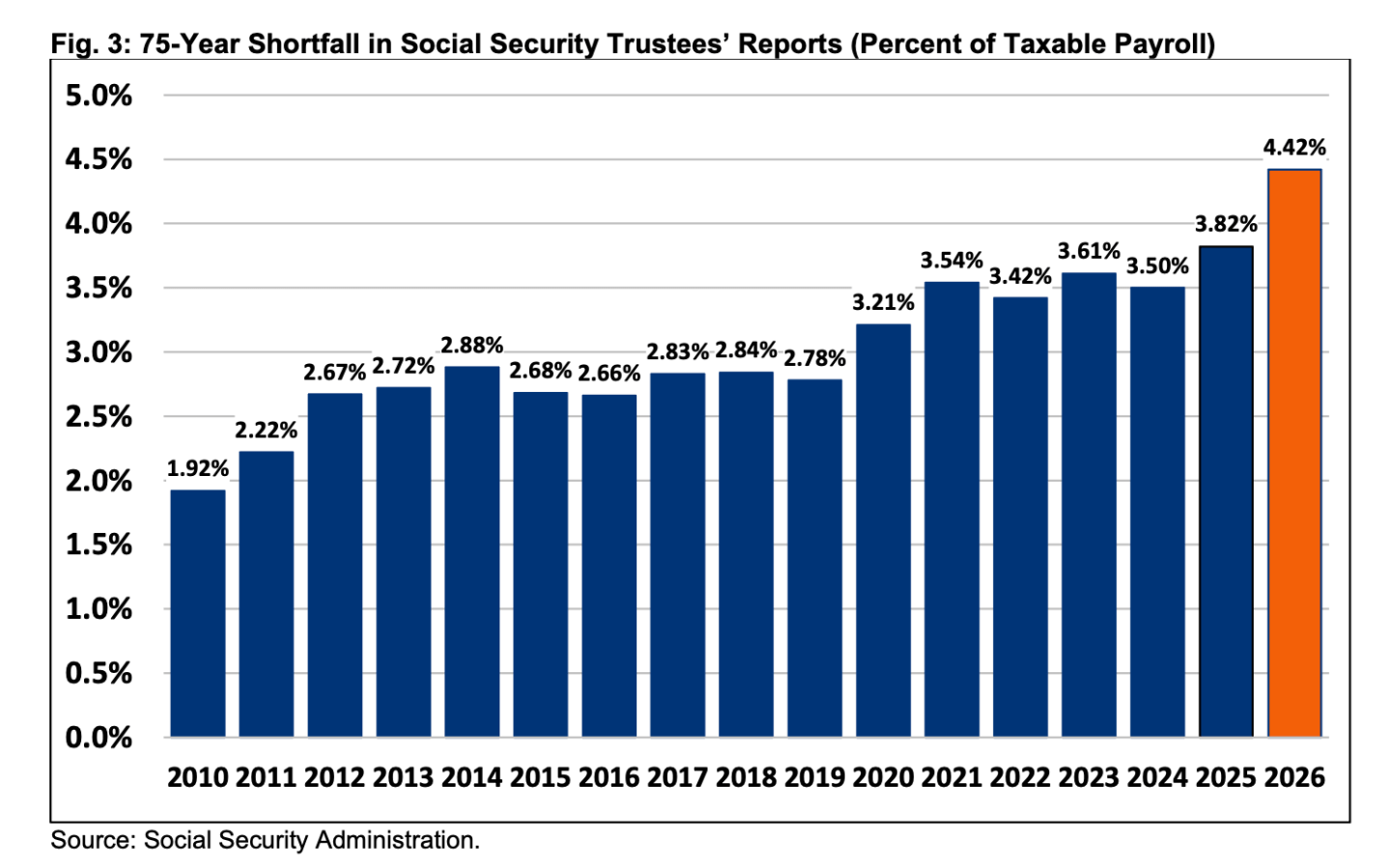
The 75-year actuarial shortfall has ballooned to 4.42% of taxable payroll, the largest since 1977, and equivalent to $31 trillion in present value—roughly the size of the entire U.S. economy. This is due to lower fertility rates, a decline in immigration and the unfunded spending in the One Big Beautiful Bill, and the gap has grown 16% in a single year, jumping from the 3.82% shortfall projected in last year’s report.
For context, the program’s deficit is now 2.3x as large as it was in 2010.
Over the next decade alone, Social Security will spend $3.8 trillion more than it collects. Annual deficits are projected to grow from 2.7% of taxable payroll today to 6.6% by 2100, driven by an aging population, growing benefit generosity, and revenues that simply won’t keep pace.
Treasury Secretary Scott Bessent has repeatedly insisted the administration will not touch benefits or raise taxes to address the shortfall.
“The senior citizen does not pay more taxes and the senior citizen does not get less benefits,” Bessent told Congress earlier this month, framing faster economic growth—not structural reform—as the White House’s answer to a looming $31 trillion gap. His “3-3-3” framework—targeting 3% real GDP growth, 3% deficit-to-GDP, and 3 million additional barrels of daily energy production—has become the administration’s default response when pressed on specifics. Critics note the plan offers no direct mechanism to shore up the trust funds before the 2032 deadline.
Prominent economists and fiscal voices aren’t buying it. In a column published in Fortune, Johns Hopkins economist Steve Hanke and former U.S. Comptroller General David Walker (a former Social Security trustee himself) called for an emergency bipartisan fiscal commission—modeled on historical precedents —to generate binding, up-or-down reform votes in Congress, arguing the two programs together represent 36% of all federal spending and can no longer be deferred.
Writing in the New York Times, Harvard economist Jason Furman was equally blunt, having previously argued that reforms to Social Security and Medicare to eliminate their actuarial deficits must be a central pillar of any serious deficit-reduction framework, not an afterthought.
“I worked in the White House,” he wrote. “We never imagined the problem would get this bad.”
Meanwhile, Brookings researchers noted the troubling irony that the Trustees’ report arrived more than two months late and without the sign-off of two public trustee positions that have sat vacant for over a decade—a sign, they wrote, that Washington is moving backwards on reform.
A policy own goal
Deteriorating demographics explain most of the worsening outlook—but not all of it.
The Trustees lowered their projected fertility rate from 1.9 to 1.75 children per woman, reflecting the ongoing decline in U.S. births, which alone accounts for 0.35 percentage points of the widened shortfall. Reduced immigration assumptions—the model now projects 1.2 million temporary or unlawfully present immigrants annually instead of 1.35 million—added another 0.21 percentage points.
But the third-largest contributor is a policy choice: the One Big Beautiful Bill Act, signed into law earlier this year, which cut taxes on Social Security benefits. The CRFB estimates the law reduced the actuarial balance by 0.16% of payroll, accounting for roughly a quarter of the year-over-year deterioration. The law also worsened Medicare’s Hospital Insurance trust fund shortfall by an additional 0.09% of payroll.
“A quarter of the increase was due to the enactment of the One Big Beautiful Bill Act, which reduced revenue from the income taxation of Social Security benefits,” the CRFB noted—a finding that puts the legislation in direct tension with the retirement security of the very voters it was designed to benefit.
The window is closing
Lawmakers still have options, but the menu is shrinking fast.
Acting today, Congress could restore long-term solvency through a 34% payroll tax increase (about 4.25 percentage points), a 25% cut in total benefits, or a 30% reduction for new beneficiaries. Wait until 2034, and those numbers jump: a 40% tax increase or a 29% benefit cut for everyone. Cutting benefits for new beneficiaries alone would become mathematically impossible to close the gap—even if those benefits were eliminated entirely.
Reforms that once seemed like silver bullets have lost their potency. Eliminating the payroll tax cap—currently set at $184,500 in wages—would now close only about half of the solvency gap, the CRFB found.
“Many options that would have once restored solvency are no longer available,” the watchdog wrote. “Continued inaction has the potential to take even more reforms off the table.”
A typical couple retiring in 2033 would face an $18,400 annual reduction in benefits if no action is taken before the trust fund runs out, which would be a life-altering income loss for households that have spent decades planning around those payments.
No state is spared
The impact won’t be evenly distributed, but it will be universal.
“No state will be spared from these cuts,” the CRFB warned, pointing to its own state-by-state analysis of what benefit reductions would mean on the ground.
The Trustees themselves urged lawmakers to act, recommending they “address the projected trust fund shortfalls in a timely way in order to phase in necessary changes gradually and give workers and beneficiaries time to adjust.”
Solutions proposed by the CRFB’s Trust Fund Solutions Initiative include a “Six Figure Limit” on high earners’ benefits, a COLA cap, and a new Employer Compensation Tax—ideas designed to restore solvency while preserving retirement security and promoting economic growth.
“By failing to reform Social Security and Medicare,” the CRFB concluded, “policymakers are implicitly endorsing deep benefit and service cuts for most current and future beneficiaries.”
The clock, the report makes clear, is ticking—and it’s now just six years from midnight.