



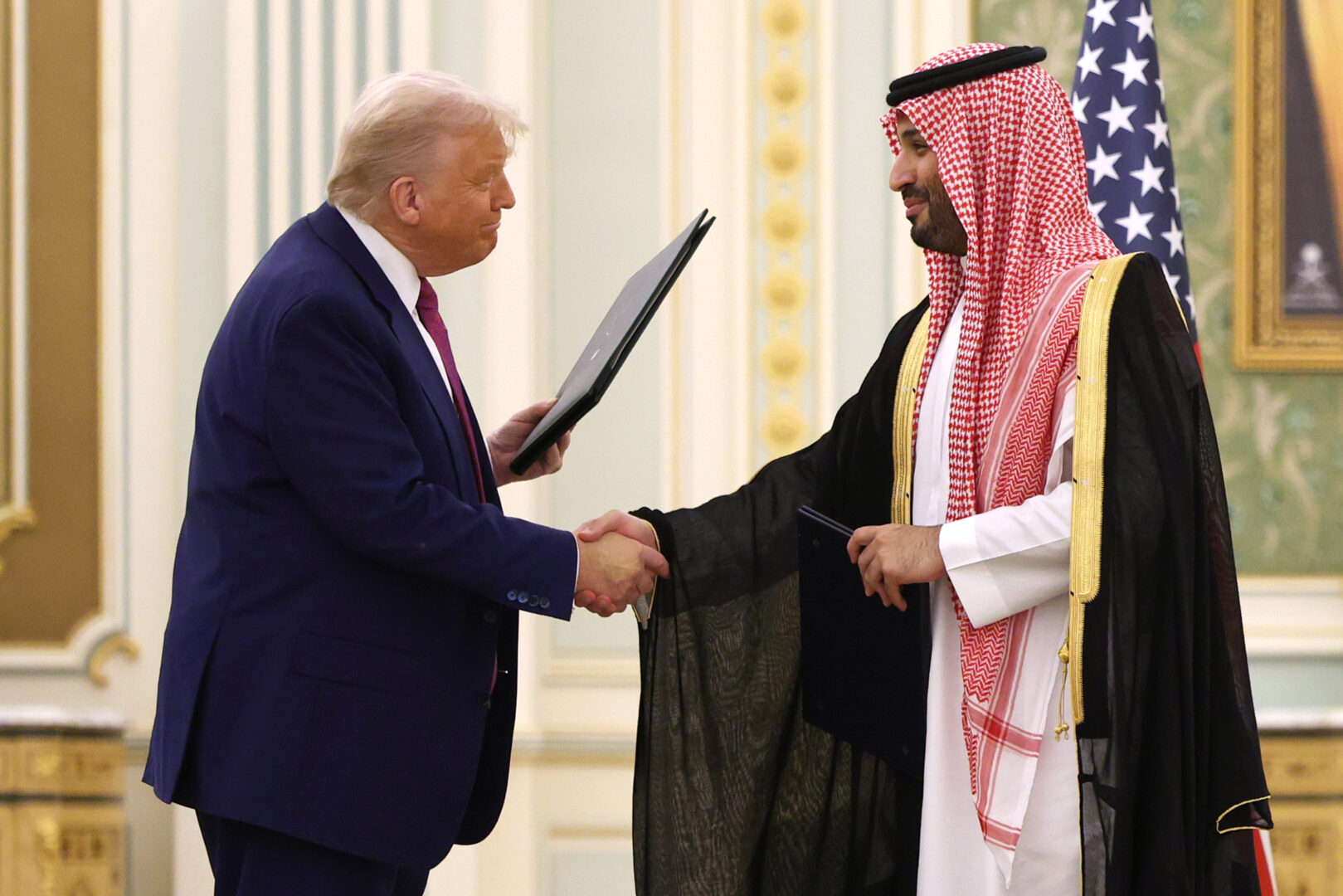
JERUSALEM – As President Donald Trump focuses on cutting new deals during his first major foreign trip to Arab Gulf states this week, questions still linger over the long-term impact of the termination of hundreds of millions of dollars in foreign aid supporting the Palestinians.
“What we are seeing now is a slow, brutal process of mass starvation and death by the denial of basic necessities,” said Sen. Bernie Sanders, I-Vt., in a Thursday speech on the Senate floor. “This is methodical, it is intentional, it is the stated policy of the [Benjamin] Netanyahu government.”
While the congressional spotlight is focused on the humanitarian crisis in the Gaza Strip, the evaporation of U.S. development assistance has put the future economic viability of a sovereign state for Palestinians even further at risk.
Take Palestinian businessman Mahmoud Khweis for example: A Harvard-educated management executive, Khweis has worked for several international organizations such as the World Bank, the United Nations and U.S. Agency for International Development. He currently runs a health technology incubator for Palestinian entrepreneurs, but the lack of development funding has left his venture on uncertain financial footing.
The first-of-its-kind technology accelerator in East Jerusalem brings together Palestinian, Israeli and American academics to support a small corps of Palestinian inventors in their goals of developing and marketing their health technology devices to a regional or even global audience.
Housed in a bright and cheerful WeWork-style office on the upper floor of a Palestinian business center in East Jerusalem, Jinnovate is in its third year and now supports 14 early-stage startups.
Under a brief softening in policies toward the Palestinians during the previous centrist Israeli coalition government of Naftali Bennett and Yair Lapid, the technology incubator received some seed funding from the Israeli Innovation Authority as well as a $150,000 grant from USAID.
Khweis, the founder of Jinnovate, told a group of visiting international journalists in March that the small USAID grant had just concluded when Trump’s executive order in January to freeze all foreign aid went into effect.
Even though he was not optimistic about a restarting of the funds, Khweis said if there ever were a project that aligned with the long-standing bipartisan goal of establishing a two-state solution, it was efforts like Jinnovate, which offer young Palestinians an alternative to the extremism espoused by Hamas. One of his organization’s goals is to increase employment opportunities.
“Our youngsters will have vision, will have motivation, they’ll start thinking about their future, they’ll start thinking about their kids, they’ll start thinking about buying houses,” said Khweis. “Better economy, it means less violence, it means impact on the political level as well.”
Among the Palestinian health tech startups that Jinnovate supports is AI-powered software for interpreting electrocardiogram readings and a company that has developed a new surgical device to make opening and closing the large sternum chest bone cleaner, decreasing recovery time for patients. Support from the accelerator includes office space, mentorship, business development training and networking opportunities.
As part of its underwriting of the Oslo peace accords, the U.S. government since 1993 has provided over $7.6 billion in foreign aid to Palestinians in the West Bank and Gaza, much of it flowing through USAID, which Trump is aiming to permanently shutter by July.
In November, USAID said it had provided over $600 million in economic support to Palestinians since 2021. Separately, a since-deleted USAID fact sheet detailed roughly $200 million in planned investments authorized by Congress as part of the 2020 Middle East Partnership for Peace Act that was folded into an omnibus spending law that Trump signed at the end of his first term. It is not clear how much of the funding was disbursed before Trump halted the MEPPA funds.
Virtually all of USAID’s mission projects for the West Bank and Gaza were included in a list of terminated activities that was transmitted to Congress but not published, according to Larry Garber, a policy fellow with the liberal pro-Israel advocacy group J Street.
Humanitarian aid cliff
Israel has threatened to launch a fresh campaign to fully militarily reoccupy Gaza in the coming days, casting a pall over Trump’s meetings this week with wealthy Gulf leaders and renewing concerns about the immediate humanitarian crisis in the besieged Palestinian territory.
In addition to the termination of almost all USAID foreign aid to Gaza, a Biden administration-imposed freeze on funding to the U.N. refugee agency dedicated to Palestinians remains in place. And Trump-imposed cutbacks to the U.N.-led World Food Program, which also provides support to the Palestinians, are projected to result in a 40 percent loss in total funding, according to press reports.
The drastic drop-off in U.S. assistance preceded a total blockade on humanitarian aid into Gaza imposed by Israel in early March.
Democrats in Congress have demanded that Trump oppose any Israeli proposal to permanently reoccupy Gaza. They also want to see the creation of an Arab-led security force to support the administration of Gaza without Hamas.
“This is a dangerous inflection point for Israel and the region, and while we support ongoing efforts to eliminate Hamas, a full-scale reoccupation of Gaza would be a critical strategic mistake,” reads a May 9 letter sent to Trump signed by 25 members of the Senate Democratic Caucus, including Defense Appropriations Subcommittee ranking member Chris Coons of Delaware and Foreign Relations Committee ranking member Jeanne Shaheen of New Hampshire.
If the Israeli-imposed blockade is maintained, the entire 2.1 million population of Gaza is projected by the end of the summer to face a “crisis” level or higher for famine, the world’s leading expert body on food crises, the Integrated Food Security Phase Classification Initiative, warned in a Monday report.
As part of its plan to fully militarily reoccupy Gaza in the coming days, Israel has proposed an aid distribution plan involving the use of private U.S. security contractors to oversee the dispersal of aid parcels in a few specific areas in the southern part of the territory. The plan has been roundly rejected by humanitarian organizations as operationally impractical and in violation of various principles of international humanitarian law.
The hard-right government of Israeli Prime Minister Benjamin Netanyahu has argued that the previous approach of allowing organizations like the U.N. Relief and Works Agency for Palestine Refugees to distribute humanitarian aid in Gaza allowed Hamas to benefit from the aid.
Political observers note that administration will need to navigate complex political optics as Trump meets with leaders in Saudi Arabia, Qatar and the United Arab Emirates this week.
“There’s an expectation that [Trump] isn’t going to want the whole story to be about the horrible situation in Gaza so he has an interest and his team has an interest in showing that somehow they’ve helped solve the humanitarian situation,” said Garber, a former senior official at USAID who spent five years as mission director of the West Bank-Gaza office. “He’s going to be pressed by the Arab countries he’s visiting on these issue because their populations are seeing the horrific pictures of what is going on in Gaza so something will have to give.”
Travel to Israel for this report was supported by the American Middle East Press Association.
JERUSALEM – As President Donald Trump focuses on cutting new deals during his first major foreign trip to Arab Gulf states this week, questions still linger over the long-term impact of the termination of hundreds of millions of dollars in foreign aid supporting the Palestinians.
“What we are seeing now is a slow, brutal process of mass starvation and death by the denial of basic necessities,” said Sen. Bernie Sanders, I-Vt., in a Thursday speech on the Senate floor. “This is methodical, it is intentional, it is the stated policy of the [Benjamin] Netanyahu government.”
While the congressional spotlight is focused on the humanitarian crisis in the Gaza Strip, the evaporation of U.S. development assistance has put the future economic viability of a sovereign state for Palestinians even further at risk.
Take Palestinian businessman Mahmoud Khweis for example: A Harvard-educated management executive, Khweis has worked for several international organizations such as the World Bank, the United Nations and U.S. Agency for International Development. He currently runs a health technology incubator for Palestinian entrepreneurs, but the lack of development funding has left his venture on uncertain financial footing.
The first-of-its-kind technology accelerator in East Jerusalem brings together Palestinian, Israeli and American academics to support a small corps of Palestinian inventors in their goals of developing and marketing their health technology devices to a regional or even global audience.
Housed in a bright and cheerful WeWork-style office on the upper floor of a Palestinian business center in East Jerusalem, Jinnovate is in its third year and now supports 14 early-stage startups.
Under a brief softening in policies toward the Palestinians during the previous centrist Israeli coalition government of Naftali Bennett and Yair Lapid, the technology incubator received some seed funding from the Israeli Innovation Authority as well as a $150,000 grant from USAID.
Khweis, the founder of Jinnovate, told a group of visiting international journalists in March that the small USAID grant had just concluded when Trump’s executive order in January to freeze all foreign aid went into effect.
Even though he was not optimistic about a restarting of the funds, Khweis said if there ever were a project that aligned with the long-standing bipartisan goal of establishing a two-state solution, it was efforts like Jinnovate, which offer young Palestinians an alternative to the extremism espoused by Hamas. One of his organization’s goals is to increase employment opportunities.
“Our youngsters will have vision, will have motivation, they’ll start thinking about their future, they’ll start thinking about their kids, they’ll start thinking about buying houses,” said Khweis. “Better economy, it means less violence, it means impact on the political level as well.”
Among the Palestinian health tech startups that Jinnovate supports is AI-powered software for interpreting electrocardiogram readings and a company that has developed a new surgical device to make opening and closing the large sternum chest bone cleaner, decreasing recovery time for patients. Support from the accelerator includes office space, mentorship, business development training and networking opportunities.
As part of its underwriting of the Oslo peace accords, the U.S. government since 1993 has provided over $7.6 billion in foreign aid to Palestinians in the West Bank and Gaza, much of it flowing through USAID, which Trump is aiming to permanently shutter by July.
In November, USAID said it had provided over $600 million in economic support to Palestinians since 2021. Separately, a since-deleted USAID fact sheet detailed roughly $200 million in planned investments authorized by Congress as part of the 2020 Middle East Partnership for Peace Act that was folded into an omnibus spending law that Trump signed at the end of his first term. It is not clear how much of the funding was disbursed before Trump halted the MEPPA funds.
Virtually all of USAID’s mission projects for the West Bank and Gaza were included in a list of terminated activities that was transmitted to Congress but not published, according to Larry Garber, a policy fellow with the liberal pro-Israel advocacy group J Street.
Humanitarian aid cliff
Israel has threatened to launch a fresh campaign to fully militarily reoccupy Gaza in the coming days, casting a pall over Trump’s meetings this week with wealthy Gulf leaders and renewing concerns about the immediate humanitarian crisis in the besieged Palestinian territory.
In addition to the termination of almost all USAID foreign aid to Gaza, a Biden administration-imposed freeze on funding to the U.N. refugee agency dedicated to Palestinians remains in place. And Trump-imposed cutbacks to the U.N.-led World Food Program, which also provides support to the Palestinians, are projected to result in a 40 percent loss in total funding, according to press reports.
The drastic drop-off in U.S. assistance preceded a total blockade on humanitarian aid into Gaza imposed by Israel in early March.
Democrats in Congress have demanded that Trump oppose any Israeli proposal to permanently reoccupy Gaza. They also want to see the creation of an Arab-led security force to support the administration of Gaza without Hamas.
“This is a dangerous inflection point for Israel and the region, and while we support ongoing efforts to eliminate Hamas, a full-scale reoccupation of Gaza would be a critical strategic mistake,” reads a May 9 letter sent to Trump signed by 25 members of the Senate Democratic Caucus, including Defense Appropriations Subcommittee ranking member Chris Coons of Delaware and Foreign Relations Committee ranking member Jeanne Shaheen of New Hampshire.
If the Israeli-imposed blockade is maintained, the entire 2.1 million population of Gaza is projected by the end of the summer to face a “crisis” level or higher for famine, the world’s leading expert body on food crises, the Integrated Food Security Phase Classification Initiative, warned in a Monday report.
As part of its plan to fully militarily reoccupy Gaza in the coming days, Israel has proposed an aid distribution plan involving the use of private U.S. security contractors to oversee the dispersal of aid parcels in a few specific areas in the southern part of the territory. The plan has been roundly rejected by humanitarian organizations as operationally impractical and in violation of various principles of international humanitarian law.
The hard-right government of Israeli Prime Minister Benjamin Netanyahu has argued that the previous approach of allowing organizations like the U.N. Relief and Works Agency for Palestine Refugees to distribute humanitarian aid in Gaza allowed Hamas to benefit from the aid.
Political observers note that administration will need to navigate complex political optics as Trump meets with leaders in Saudi Arabia, Qatar and the United Arab Emirates this week.
“There’s an expectation that [Trump] isn’t going to want the whole story to be about the horrible situation in Gaza so he has an interest and his team has an interest in showing that somehow they’ve helped solve the humanitarian situation,” said Garber, a former senior official at USAID who spent five years as mission director of the West Bank-Gaza office. “He’s going to be pressed by the Arab countries he’s visiting on these issue because their populations are seeing the horrific pictures of what is going on in Gaza so something will have to give.”
Travel to Israel for this report was supported by the American Middle East Press Association.