



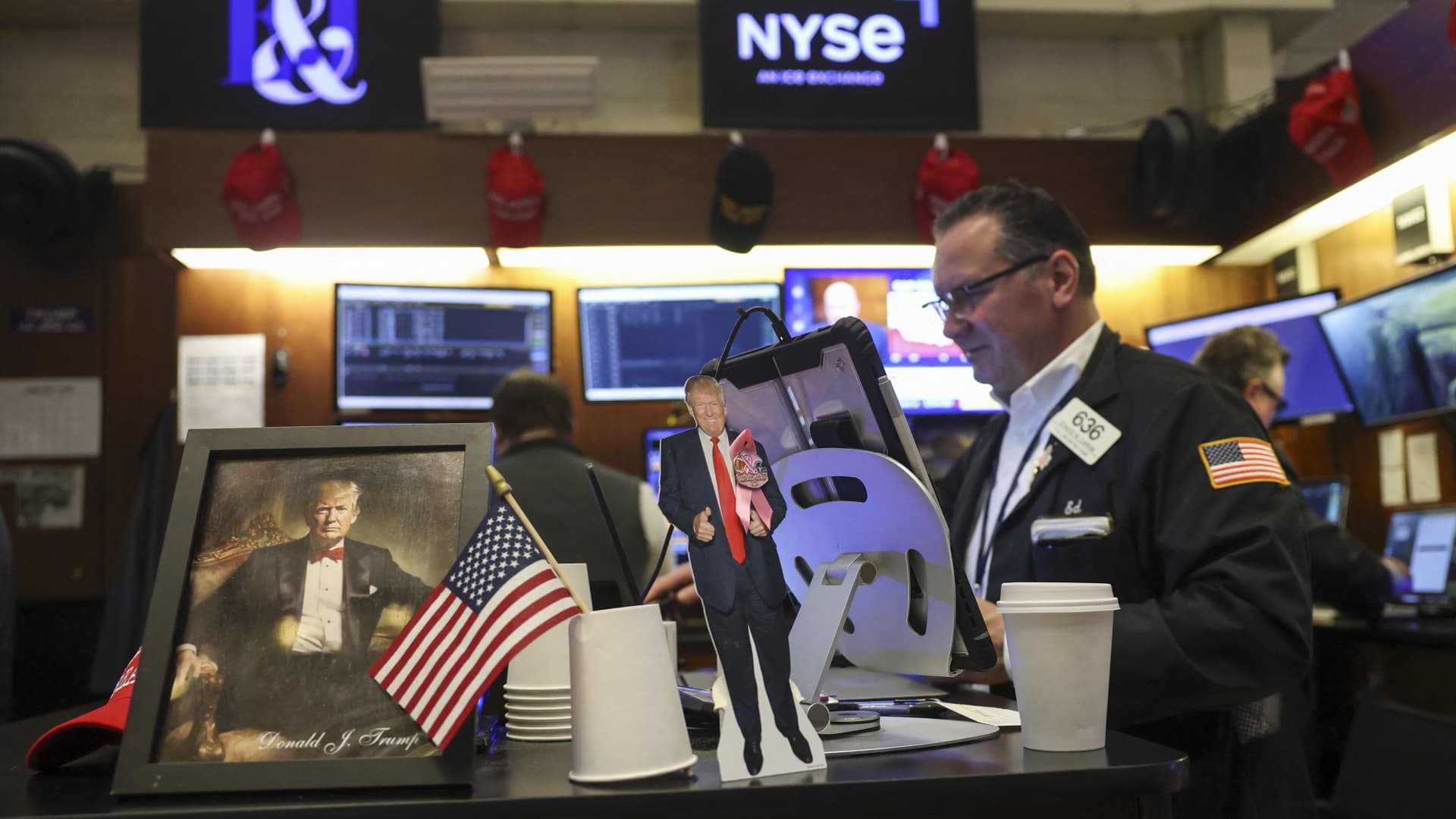
Traders work on the floor of the New York Stock Exchange on Jan. 12, 2026.
Angela Weiss | Afp | Getty Images
The first two weeks of 2026 have seen U.S. President Donald Trump’s administration capture Venezuela’s president, threaten to respond to Iran’s violent crackdown on protests, and talk up the possibility of using force to seize Greenland. So why are stocks rising?
The headlines have caused price swings in asset classes like gold, silver and oil as traders sought safe havens and weighed the impact a U.S. intervention in the Middle East could have on oil supply.
Read more
Equity markets, however, appear to be shrugging off the news. The S&P 500 has had just three losing sessions since markets began the new trading year, and was up around 1.5% year-to-date at Thursday’s close. Europe, Latin America and the Middle East, where the tensions hit much closer to home, have also risen, as have Asia-Pacific stocks.
The U.S. view
Wall Street’s three major averages have made gains despite the news, appearing to shrug off U.S. President Donald Trump’s apparent willingness to order military operations overseas and threats to take territory from a close ally by force.
Alongside the S&P 500’s gain, Wall Street’s two other major averages are up this year: the Dow Jones Industrial Average has added close to 3%, while tech-heavy Nasdaq Composite is up 1.2%.

S&P 500
Eric Freedman, chief investment officer for Chicago-based Northern Trust Wealth Management, which manages assets worth $492.6 billion, said markets hadn’t been moved by Trump’s actions and rhetoric on Iran, Venezuela, and Greenland partly because no other large economic or military powers had responded.
“Markets are looking at these events in isolation, and it would likely take a unique response to each flare-up to drive more market agita,” he told CNBC in an email. “We don’t want to speculate what subsequent actions may follow, but what we would be concerned with beyond the human conditions in a given region would be if lines are drawn that impact trade in an increasingly sequestered world.”

A U.S. Supreme Court ruling is due soon on the legality of Trump’s tariffs, but, in the meantime, global investors appear to have adapted to the White House’s 2025 pivots, Freedman said.
“Increased flare ups beyond what has occurred already could push countries to revisit trade ties or threaten sanctions, but until they arrive, markets will remain in more reactive mode if an event happens and not necessarily adjust portfolio positioning now in anticipation of an event,” he added. “If markets were leaning into prescriptive positioning or the thought that taking defensive measures was appropriate because flare-up probabilities were increasing, we would likely see a weaker U.S. dollar.”
The U.S. dollar index, which measures the greenback against a basket of major rivals, has risen by around 1% since the beginning of the year.
Equity market ‘meh’
Alex Morris, CEO of Washington, D.C.-headquartered F/m Investments, called stock market investors’ reactions “equity market ‘meh’.”
“Geopolitics are simmering, but not boiling over,” he said. “The president’s use of highly targeted shows of force but low-time and personnel in-theater operations leaves markets little to react to.
“Short-lived and final events (no ongoing commitment) give little for markets to react to. News happens and that’s it. It also helps there has been no meaningful response from Iran or Venezuela.”
Morris argued that the market’s muted reaction was underpinned by a “growing inurement” to what the Trump says, and increasingly, to what he does.

“Despite substantial action, there is little the president is unwilling to immediately backtrack on and much of the flood the zone action has been undone or overturned,” he added. “The market has learned to temper enthusiasm and wait for receipts.”
Anthony Esposito, founder and CEO of AscalonVI Capital, said markets have not cared to discount geopolitical risk for some time now.
“Israel bombs Iran – the S&P 500 was down 1% overnight and closed down just 50bps. U.S. bombs Iran – almost no reaction,” he told CNBC.
“Venezuela, Greenland could be seen as positives for the markets and even GDP in the U.S., [but] with no regard for the what ifs,” he said, noting that energy production, rare earth procurement, national security and infrastructure expansion were all at play.
Security forces are seen during a pro-government rally on Jan. 12, 2026 in Tehran, Iran.
Getty Images | Getty Images News | Getty Images
“Iran is the wild card,” he added, saying the market slid earlier this week “until Trump settled fears,” by seeming to back away from military action. “If there was an event in Iran the market would react (oil up, stocks down, gold up) but aside from that the markets are focused on rates, growth, earnings and the Trump agenda.”
European rally
Stocks in Europe have also strengthened even amid questions about the future of Greenland, a self-governing Danish territory in the Arctic, and what Trump’s determination to take the island could mean for NATO and continental defense. The pan-European Stoxx 600 has added almost 4%.
“Bottom line, there is a lot of issues but as yet, they haven’t created an impact via investor sentiment or activity,” said Toni Meadows, head of investment at U.K.-based BRI Wealth Management.
“This might not always be the case,” he added. “Greenland is [the] bigger deal in terms of impact as this is an argument within NATO, so if at some point the market believes Trump’s threat to make it a military conflict then markets will react,” he said. “But for now, it is a case of stay close to the news flow.”
Benjamin Jones, global head of research at Invesco, told CNBC in an email that historically, geopolitics, military conflicts, and unconventional policy haven’t weighed on portfolios as much as investors fear.
Markets are callous and only react meaningfully when these events impact economic fundamentals or lead to a change in policy.
Benjamin Jones
Global Head of Research at Invesco
“Many geopolitical events are troubling, but markets are callous and only react meaningfully and sustainably when these events impact economic fundamentals or lead to a change in policy,” he said.
“History is clear, equity markets have historically performed well in the 12 months following a spike in geopolitical risk.”
Asian stocks on the rise
In fact, the MSCI AC Asia Pacific Index, which tracks large and mid-cap stocks across 15 Asia-Pacific countries, has risen over 5% this year to a record high. Japan’s benchmark Nikkei 225 and South Korea’s Kospi similarly reached all-time highs in recent days.
Market watchers said the increases are not investors being complacent, but fundamentals like the absence of major oil shocks and the expectation that easier monetary policy and AI spending will continue to underpin earnings growth.
“The impact of geopolitical events would usually transmit to global markets via the oil price but the oil market is not seeing significant shocks so far,” said Yap Fook Hien, senior investment strategist at Standard Chartered.
A tee shirt saying “Greenland is not for sale” is on display in a shop in Nuuk, Greenland, on January 15, 2026.
Alessandro Rampazzo | Afp | Getty Images
Yap added that Asian investors and global equity markets are driven more by policy stimulus, including U.S. rate cuts and AI investments, all of which support a strong outlook for earnings growth this year.
“Geopolitics remain a key risk but the shock since Liberation Day in April 2025 has conditioned markets to respond more calmly to Trump’s actions,” he said.
Morningstar’s Southeast Asia managing director, Shihan Abeyguna, told CNBC that markets may now view geopolitics as “a chronic risk rather than an acute shock.”
He added that Asia valuations are not stretched enough to make markets vulnerable to prolonged drawdowns without a genuine shock.
Geopolitical concerns in the region “tend to be more calibrated, so it would need to be a true unexpected shock that would alter earnings expectations,” said Abeyguna.
Traders work on the floor of the New York Stock Exchange on Jan. 12, 2026.
Angela Weiss | Afp | Getty Images
The first two weeks of 2026 have seen U.S. President Donald Trump’s administration capture Venezuela’s president, threaten to respond to Iran’s violent crackdown on protests, and talk up the possibility of using force to seize Greenland. So why are stocks rising?
The headlines have caused price swings in asset classes like gold, silver and oil as traders sought safe havens and weighed the impact a U.S. intervention in the Middle East could have on oil supply.
Read more
Equity markets, however, appear to be shrugging off the news. The S&P 500 has had just three losing sessions since markets began the new trading year, and was up around 1.5% year-to-date at Thursday’s close. Europe, Latin America and the Middle East, where the tensions hit much closer to home, have also risen, as have Asia-Pacific stocks.
The U.S. view
Wall Street’s three major averages have made gains despite the news, appearing to shrug off U.S. President Donald Trump’s apparent willingness to order military operations overseas and threats to take territory from a close ally by force.
Alongside the S&P 500’s gain, Wall Street’s two other major averages are up this year: the Dow Jones Industrial Average has added close to 3%, while tech-heavy Nasdaq Composite is up 1.2%.
S&P 500
Eric Freedman, chief investment officer for Chicago-based Northern Trust Wealth Management, which manages assets worth $492.6 billion, said markets hadn’t been moved by Trump’s actions and rhetoric on Iran, Venezuela, and Greenland partly because no other large economic or military powers had responded.
“Markets are looking at these events in isolation, and it would likely take a unique response to each flare-up to drive more market agita,” he told CNBC in an email. “We don’t want to speculate what subsequent actions may follow, but what we would be concerned with beyond the human conditions in a given region would be if lines are drawn that impact trade in an increasingly sequestered world.”
A U.S. Supreme Court ruling is due soon on the legality of Trump’s tariffs, but, in the meantime, global investors appear to have adapted to the White House’s 2025 pivots, Freedman said.
“Increased flare ups beyond what has occurred already could push countries to revisit trade ties or threaten sanctions, but until they arrive, markets will remain in more reactive mode if an event happens and not necessarily adjust portfolio positioning now in anticipation of an event,” he added. “If markets were leaning into prescriptive positioning or the thought that taking defensive measures was appropriate because flare-up probabilities were increasing, we would likely see a weaker U.S. dollar.”
The U.S. dollar index, which measures the greenback against a basket of major rivals, has risen by around 1% since the beginning of the year.
Equity market ‘meh’
Alex Morris, CEO of Washington, D.C.-headquartered F/m Investments, called stock market investors’ reactions “equity market ‘meh’.”
“Geopolitics are simmering, but not boiling over,” he said. “The president’s use of highly targeted shows of force but low-time and personnel in-theater operations leaves markets little to react to.
“Short-lived and final events (no ongoing commitment) give little for markets to react to. News happens and that’s it. It also helps there has been no meaningful response from Iran or Venezuela.”
Morris argued that the market’s muted reaction was underpinned by a “growing inurement” to what the Trump says, and increasingly, to what he does.
“Despite substantial action, there is little the president is unwilling to immediately backtrack on and much of the flood the zone action has been undone or overturned,” he added. “The market has learned to temper enthusiasm and wait for receipts.”
Anthony Esposito, founder and CEO of AscalonVI Capital, said markets have not cared to discount geopolitical risk for some time now.
“Israel bombs Iran – the S&P 500 was down 1% overnight and closed down just 50bps. U.S. bombs Iran – almost no reaction,” he told CNBC.
“Venezuela, Greenland could be seen as positives for the markets and even GDP in the U.S., [but] with no regard for the what ifs,” he said, noting that energy production, rare earth procurement, national security and infrastructure expansion were all at play.
Security forces are seen during a pro-government rally on Jan. 12, 2026 in Tehran, Iran.
Getty Images | Getty Images News | Getty Images
“Iran is the wild card,” he added, saying the market slid earlier this week “until Trump settled fears,” by seeming to back away from military action. “If there was an event in Iran the market would react (oil up, stocks down, gold up) but aside from that the markets are focused on rates, growth, earnings and the Trump agenda.”
European rally
Stocks in Europe have also strengthened even amid questions about the future of Greenland, a self-governing Danish territory in the Arctic, and what Trump’s determination to take the island could mean for NATO and continental defense. The pan-European Stoxx 600 has added almost 4%.
“Bottom line, there is a lot of issues but as yet, they haven’t created an impact via investor sentiment or activity,” said Toni Meadows, head of investment at U.K.-based BRI Wealth Management.
“This might not always be the case,” he added. “Greenland is [the] bigger deal in terms of impact as this is an argument within NATO, so if at some point the market believes Trump’s threat to make it a military conflict then markets will react,” he said. “But for now, it is a case of stay close to the news flow.”
Benjamin Jones, global head of research at Invesco, told CNBC in an email that historically, geopolitics, military conflicts, and unconventional policy haven’t weighed on portfolios as much as investors fear.
Markets are callous and only react meaningfully when these events impact economic fundamentals or lead to a change in policy.
Benjamin Jones
Global Head of Research at Invesco
“Many geopolitical events are troubling, but markets are callous and only react meaningfully and sustainably when these events impact economic fundamentals or lead to a change in policy,” he said.
“History is clear, equity markets have historically performed well in the 12 months following a spike in geopolitical risk.”
Asian stocks on the rise
In fact, the MSCI AC Asia Pacific Index, which tracks large and mid-cap stocks across 15 Asia-Pacific countries, has risen over 5% this year to a record high. Japan’s benchmark Nikkei 225 and South Korea’s Kospi similarly reached all-time highs in recent days.
Market watchers said the increases are not investors being complacent, but fundamentals like the absence of major oil shocks and the expectation that easier monetary policy and AI spending will continue to underpin earnings growth.
“The impact of geopolitical events would usually transmit to global markets via the oil price but the oil market is not seeing significant shocks so far,” said Yap Fook Hien, senior investment strategist at Standard Chartered.
A tee shirt saying “Greenland is not for sale” is on display in a shop in Nuuk, Greenland, on January 15, 2026.
Alessandro Rampazzo | Afp | Getty Images
Yap added that Asian investors and global equity markets are driven more by policy stimulus, including U.S. rate cuts and AI investments, all of which support a strong outlook for earnings growth this year.
“Geopolitics remain a key risk but the shock since Liberation Day in April 2025 has conditioned markets to respond more calmly to Trump’s actions,” he said.
Morningstar’s Southeast Asia managing director, Shihan Abeyguna, told CNBC that markets may now view geopolitics as “a chronic risk rather than an acute shock.”
He added that Asia valuations are not stretched enough to make markets vulnerable to prolonged drawdowns without a genuine shock.
Geopolitical concerns in the region “tend to be more calibrated, so it would need to be a true unexpected shock that would alter earnings expectations,” said Abeyguna.