


Coffee traceability challenges summarised
- Coffee has a complex, fragmented supply chain
- Many farms are remote and difficult to access
- Building trust with smallholders takes time and effort
- Coffee deforestation is difficult to detect using satellite data, leading to false positives
- Many of the larger players in the coffee sector are ready for the EUDR, while smaller businesses face challenges
As the EUDR approaches, businesses must be able to trace relevant crops back to their source.
But this is easier said than done. Global, multi-faceted supply chains can be almost impossible to follow, and tracing coffee in particular poses significant difficulties for manufacturers.
1. Complexity of supply chains
Much like cocoa, coffee has a complex supply chain, with many stages between the growing of the beans and the drinking of the coffee.
“Coffee is produced by millions of smallholder farmers in remote areas, mixed very early in the value chain and often passing through intermediaries before reaching exporters. This makes it difficult to gather precise, verifiable information on origin, and land use,” explains a spokesperson for the International Coffee Organisation (ICO), a coffee industry group.
To mitigate these issues, collaboration with governments and collective action can help reduce some of the cost burdens on individual companies and help them collect the necessary data at a local level.
“Solutions that benefit at the same time businesses, governments, farmers and forests exist and are being explored. Long-term partnerships and shared data platforms will be essential.”
2. Fragmentation of supply chains
Stemming from this issue, supply chains are often also highly fragmented, with around 70% of coffee produced by smallholder farmers, the ICO spokesperson explains.
“This dispersion, combined with informal trade channels and co-mingling of lots at local mills or cooperatives, makes coffee particularly challenging to trace.”
This is exacerbated by fragmented data collection systems and limited digital infrastructure in some places.
Investment in digital tools for geolocation, as well as record-keeping methods such as using blockchain technology, can mitigate these issues, explains the ICO spokesperson, ensuring farm-level traceability.

3. Remoteness of farms
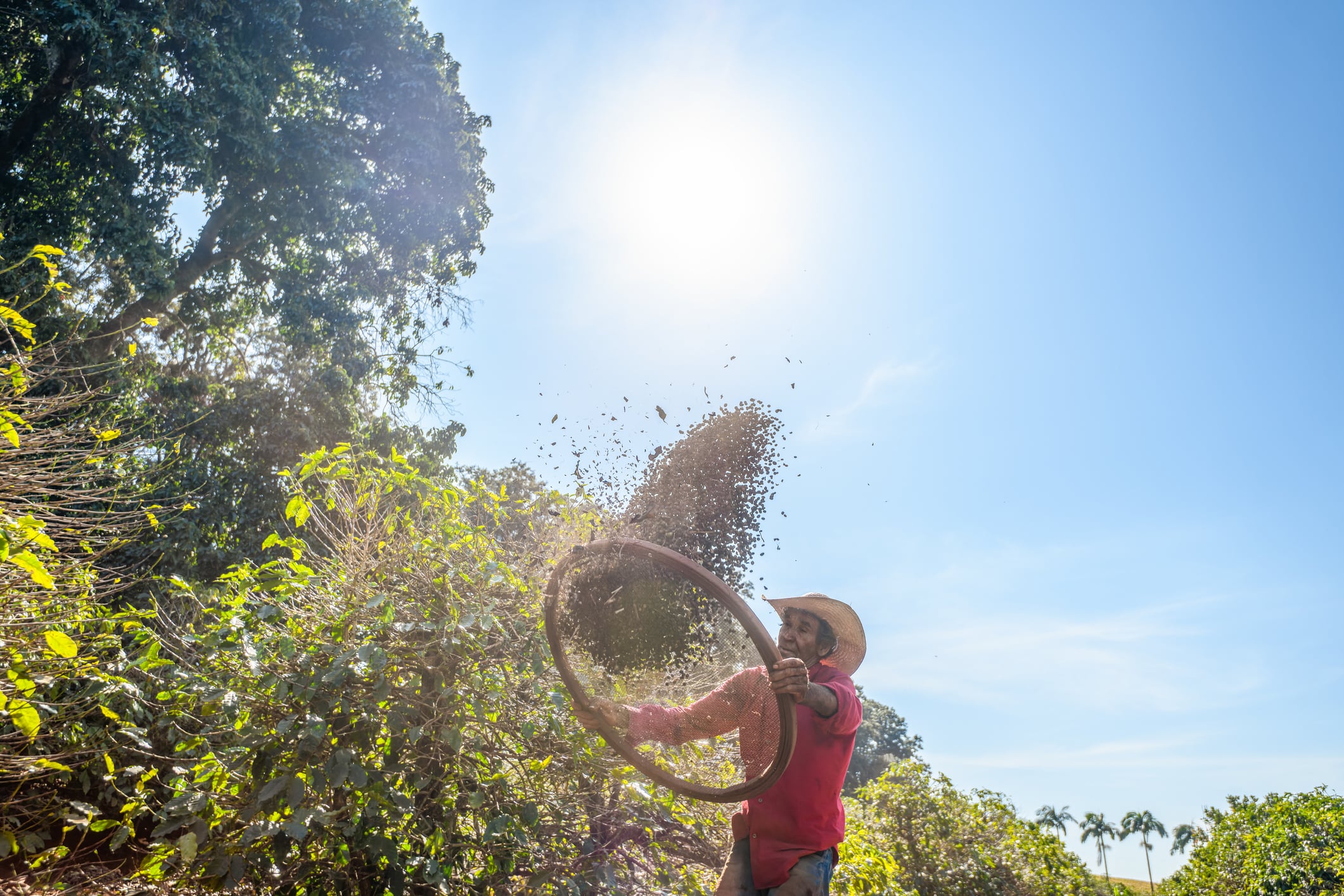
Coffee farms are not always easy to reach. Some are very remote, and are only accessible on foot or via moped.
“Mapping smallholder farms, in sometimes remote and inaccessible areas, is a real physical and logistical challenge, requiring a large field effort with trained enumerators using handheld digital tools,” explains Jeremy Dufour, head of sustainability execution for coffee at ingredients company OFI.
Even for a company such as OFI, which has both on-the-ground presence and a large swathe of resources, mapping the whole supply chain and the innumerable small farms it contains can be a challenge.
4. Building trust
Because of the remoteness of many cocoa farmers, building trust can be hard. But it is vital if you are to maintain strong relationships with growers and have clear sourcing locations.
The challenge of sourcing “is compounded by the need to build trust in traditional local sourcing networks and sometimes by the need to reach beyond local intermediaries with influence, who may be protective of their supply base,” explains OFI’s Dufour.
Enumerators employed or trained by companies such as OFI must travel to farms and explain to farmers why they need to walk farm boundaries in order to map them.
These enumerators, Dufour explains, often only manage three or four farms a day, making it difficult to access the hundreds and thousands of smallholder suppliers in sourcing networks.
5. Difficulties with observation
Coffee is a perennial crop, meaning it does not die after harvest and flowers throughout the year.
This means that monitoring compliance requires long-term observation, rather than simply seasonal verification.
Alongside the added difficulties of monitoring coffee long-term, it can also be more difficult to detect using satellite data, due to often being grown in shaded forest.
“The majority of the coffee in the world is produced under shadow trees, or even in forests with a canopy of more than 80%,” explains the ICO spokesperson.
“The usual methods based on satellite images lead to false positives and inefficiencies in the value chain.”
Is the coffee sector ready for the EUDR?
As always, the question of whether coffee is truly prepared for the EUDR is more than simply a ‘yes’ or ‘no’ answer.
Larger companies, with sustainability programmes in place, in many cases are quite prepared, explains the ICO spokesperson. Small and medium companies, however, face more significant challenges.
Nevertheless, there is strong collaboration between key stakeholders in many areas of the industry.
“The sector is moving quickly, with pilot projects, national governmental traceability initiatives, and industry-wide platforms being developed. An efficient and inclusive readiness will require coordinated action among governments, companies, and international organisations to ensure that no producing country or farmer group is left behind.”
Many governments are working hard to create frameworks for public-private cooperation, in order to ensure that compliance is possible, reduce costs and risks for the private sector and include all smallholder farmers.