




By Jessica Davies • May 29, 2026 •

Ivy Liu
Publishers are quietly cutting six-figure AI licensing deals on Snowflake, as the data giant positions itself as matchmaker-in-chief between locked-down news content and enterprises keen to plug reliable publisher content into their own internal AI tools via retrieval-augmented generation (RAG).
For publishers, the cloud platform’s Cortex Knowledge Extensions act as a monetized RAG pipe: a way to let enterprises query their paywalled or proprietary content inside Snowflake’s AI environment without exposing raw feeds, losing control, or getting scraped for model training.
The Washington Post, Associated Press (AP), People Inc., and USA Today Network are among the 17 publishers that have signed on to use it. Other publishers, including the Financial Times and The Economist, have previously spoken to Digiday of their interest in the RAG royalties that can come from opening their archives to private LLMs. Meanwhile, AP’s CRO Kristin Heitmann previously told Digiday the Snowflake exchange offers “unlimited use cases” covering finance companies along with companies monitoring supply chains, managing crisis and operations, and environmental and regulatory awareness.
Snowflake launched Cortex last June to address what it sees as a growing imbalance in the AI ecosystem: publishers want proper attribution, protection, and compensation for their content, while enterprises increasingly need trusted, licensed editorial content to improve AI systems alongside their own internal data, stressed Ben Srour, principal product manager at Snowflake.
“You cannot scrape the data — you can’t steal it and use it for model training. So that’s why the product has really resonated with publishers,” he told Digiday.
AI licensing, particularly enterprise RAG licensing, is a nascent incremental line for publishers, not a lifeline: it’s unlikely to plug the much larger deficit created by AI-driven referral and traffic declines that have caused many publishers pain over the last several years. But it’s a new revenue stream several publishers are excited about.
Srour said that while it’s early days, Cortex is already moving real money for some. He said that publishers had signed several “six-figure deals” with financial institutions off the back of its Cortex extension, with contracts structured either as flat-fee licenses or usage-based access and often paid out of an enterprise customer’s existing multi-year spending commitment to Snowflake (a pre-paid pool of dollars/credits.) Though he did not provide specific figures.
With Cortex extensions, a buyer can use some of the Snowflake spend they have already committed to the cloud platform, to pay a publisher for access to their content, instead of putting a new contract through procurement, he noted.
Unlike some other platforms that insist on taking a cut of media licensing deals, Srour stressed that it doesn’t skim the content fee: publishers and enterprise buyers strike their own terms directly, while Snowflake makes its money the old‑fashioned way: on storage and compute when those AI queries run.
That AI push isn’t happening in a vacuum. Earlier this month, Snowflake agreed to spend $6 billion over five years on Amazon Web Services’ custom chips and AI infrastructure, underscoring how much of its growth story now hinges on AI workloads.
According to a recent report on the emerging market for AI content licensing, published in April, AI licensing marketplaces where AI companies pay publishers and creators for access to articles, archives, and data, is developing in a way that could repeat many of the power imbalances seen during the platform era with companies like Google and Facebook. The report cited the “take rates” of these platforms.
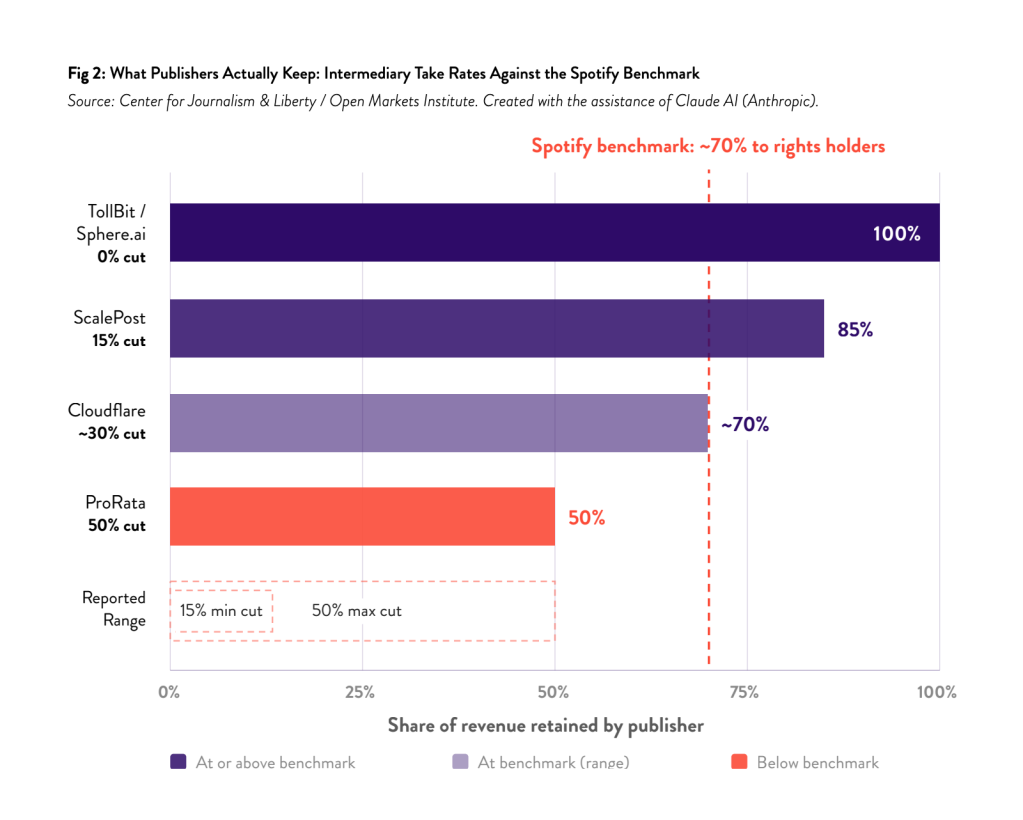
Snowflake’s “no rev share” stance is a key part of the pitch to newsrooms with already‑squeezed margins: Snowflake is effectively saying it won’t be another middleman shaving points off the top, which makes it easier for publishers to argue internally that AI licensing can be incremental upside rather than yet another channel where a platform takes the lion’s share.
Prasanna Krishnan, head of Collaboration and Horizon at Snowflake, said the Snowflake platform brings news inside the enterprise firewall. She frames Cortex as how enterprises combine their own sensitive data with outside news and analysis “from outside your own four walls” so staff (or agents) can make better decisions without spraying internal data across the open web.
That pitch lands in a market where publishers have spent the past two years grappling with AI companies scraping and ingesting their content at scale. While a handful have secured licensing deals, and others have moved to block or restrict AI crawlers, much of the industry remains stuck between limited leverage, uncertain protections, and fears of losing visibility altogether.
Cortex is also built for an agentic, paywalled future, noted Krishnan. Snowflake is betting that as agents browse the web and ignore display ads, more premium sites will lock down content — and enterprises will pay to feed that locked‑down reporting into always‑on “early‑warning systems” running on top of their own data.
On the enterprise side, Srour said demand is more pocketed but focused rather than a land rush. The keenest adopters so far are in financial services and marketing/communications verticals, where teams are already deep into building AI tools on top of their own data and now want trusted external signals to plug in.
Most other enterprises are still in the phase of getting their internal AI models and data governance up to scratch before they seriously lean into licensed publisher content, he added.
Srour said Snowflake is designing Cortex for where AI is going, not where it started: away from simple chatbots and toward always‑on agents quietly working in the background.
“A year ago we were talking a lot about chatbots… but very quickly things are moving into this, like, agentic, automated world,” he said… [agents] are doing stuff at night all the time… What do they need? They need data. They need context. They need to know what’s happening in the world.”
Snowflake’s bet now is that demand will catch up: that the same enterprises wiring up AI agents on their own data will start piping in publisher feeds too. If that happens at scale, Cortex starts to look like a real, repeatable licensing business for news publishers, not just another short‑lived hype cycle.
More in Media
By Jessica Davies • May 29, 2026 •
Ivy Liu
Publishers are quietly cutting six-figure AI licensing deals on Snowflake, as the data giant positions itself as matchmaker-in-chief between locked-down news content and enterprises keen to plug reliable publisher content into their own internal AI tools via retrieval-augmented generation (RAG).
For publishers, the cloud platform’s Cortex Knowledge Extensions act as a monetized RAG pipe: a way to let enterprises query their paywalled or proprietary content inside Snowflake’s AI environment without exposing raw feeds, losing control, or getting scraped for model training.
The Washington Post, Associated Press (AP), People Inc., and USA Today Network are among the 17 publishers that have signed on to use it. Other publishers, including the Financial Times and The Economist, have previously spoken to Digiday of their interest in the RAG royalties that can come from opening their archives to private LLMs. Meanwhile, AP’s CRO Kristin Heitmann previously told Digiday the Snowflake exchange offers “unlimited use cases” covering finance companies along with companies monitoring supply chains, managing crisis and operations, and environmental and regulatory awareness.
Snowflake launched Cortex last June to address what it sees as a growing imbalance in the AI ecosystem: publishers want proper attribution, protection, and compensation for their content, while enterprises increasingly need trusted, licensed editorial content to improve AI systems alongside their own internal data, stressed Ben Srour, principal product manager at Snowflake.
“You cannot scrape the data — you can’t steal it and use it for model training. So that’s why the product has really resonated with publishers,” he told Digiday.
AI licensing, particularly enterprise RAG licensing, is a nascent incremental line for publishers, not a lifeline: it’s unlikely to plug the much larger deficit created by AI-driven referral and traffic declines that have caused many publishers pain over the last several years. But it’s a new revenue stream several publishers are excited about.
Srour said that while it’s early days, Cortex is already moving real money for some. He said that publishers had signed several “six-figure deals” with financial institutions off the back of its Cortex extension, with contracts structured either as flat-fee licenses or usage-based access and often paid out of an enterprise customer’s existing multi-year spending commitment to Snowflake (a pre-paid pool of dollars/credits.) Though he did not provide specific figures.
With Cortex extensions, a buyer can use some of the Snowflake spend they have already committed to the cloud platform, to pay a publisher for access to their content, instead of putting a new contract through procurement, he noted.
Unlike some other platforms that insist on taking a cut of media licensing deals, Srour stressed that it doesn’t skim the content fee: publishers and enterprise buyers strike their own terms directly, while Snowflake makes its money the old‑fashioned way: on storage and compute when those AI queries run.
That AI push isn’t happening in a vacuum. Earlier this month, Snowflake agreed to spend $6 billion over five years on Amazon Web Services’ custom chips and AI infrastructure, underscoring how much of its growth story now hinges on AI workloads.
According to a recent report on the emerging market for AI content licensing, published in April, AI licensing marketplaces where AI companies pay publishers and creators for access to articles, archives, and data, is developing in a way that could repeat many of the power imbalances seen during the platform era with companies like Google and Facebook. The report cited the “take rates” of these platforms.
Snowflake’s “no rev share” stance is a key part of the pitch to newsrooms with already‑squeezed margins: Snowflake is effectively saying it won’t be another middleman shaving points off the top, which makes it easier for publishers to argue internally that AI licensing can be incremental upside rather than yet another channel where a platform takes the lion’s share.
Prasanna Krishnan, head of Collaboration and Horizon at Snowflake, said the Snowflake platform brings news inside the enterprise firewall. She frames Cortex as how enterprises combine their own sensitive data with outside news and analysis “from outside your own four walls” so staff (or agents) can make better decisions without spraying internal data across the open web.
That pitch lands in a market where publishers have spent the past two years grappling with AI companies scraping and ingesting their content at scale. While a handful have secured licensing deals, and others have moved to block or restrict AI crawlers, much of the industry remains stuck between limited leverage, uncertain protections, and fears of losing visibility altogether.
Cortex is also built for an agentic, paywalled future, noted Krishnan. Snowflake is betting that as agents browse the web and ignore display ads, more premium sites will lock down content — and enterprises will pay to feed that locked‑down reporting into always‑on “early‑warning systems” running on top of their own data.
On the enterprise side, Srour said demand is more pocketed but focused rather than a land rush. The keenest adopters so far are in financial services and marketing/communications verticals, where teams are already deep into building AI tools on top of their own data and now want trusted external signals to plug in.
Most other enterprises are still in the phase of getting their internal AI models and data governance up to scratch before they seriously lean into licensed publisher content, he added.
Srour said Snowflake is designing Cortex for where AI is going, not where it started: away from simple chatbots and toward always‑on agents quietly working in the background.
“A year ago we were talking a lot about chatbots… but very quickly things are moving into this, like, agentic, automated world,” he said… [agents] are doing stuff at night all the time… What do they need? They need data. They need context. They need to know what’s happening in the world.”
Snowflake’s bet now is that demand will catch up: that the same enterprises wiring up AI agents on their own data will start piping in publisher feeds too. If that happens at scale, Cortex starts to look like a real, repeatable licensing business for news publishers, not just another short‑lived hype cycle.