


For this week’s Fault Lines column, Jon Allsop is filling in for Jay Caspian Kang.
In 2017, when the United States, Canada, and Mexico jointly applied to host the 2026 edition of the men’s soccer World Cup—the biggest sporting event on earth—their bid led with three buzzwords: “UNITY. CERTAINTY. OPPORTUNITY.” The World Cup, their official “bid book” said, is “the greatest celebration of human togetherness in sport anywhere on the planet”; the three would-be hosts were demonstrating that they were “more than neighbors”—they were “partners.” They also promised “integrity, transparency, responsibility, and full support for fair play,” and pledged to champion “respect for human rights and respect for fundamental freedoms and values.” At the time, Donald Trump had just taken office. His Muslim travel ban was at odds with the gauzy rhetoric; he also appeared to threaten reprisals against any countries that stood in the way of the bid. In a section titled “Political Information,” the bid book acknowledged that the U.S. was “polarized” and that its image may have “suffered” overseas, but insisted that “the majority of the world” still viewed it positively. And, owing to term limits, it said, Trump could not be President in 2026.
The bid was successful—but the soccer officials behind it, as the Philadelphia Inquirer’s Will Bunch put it recently, had clearly never heard of Grover Cleveland. Last month, during Trump’s Memorial Day address at Arlington National Cemetery, he said that, in some ways, he’s glad that he didn’t serve his second term consecutively, from 2021 to 2025, because he wouldn’t have been in office for the World Cup, among other important events. “Now look what I have,” he said. “I have everything.” A few weeks earlier, at a public meeting of Trump’s World Cup-planning task force, Gianni Infantino, the Swiss-Italian president of FIFA, soccer’s global governing body, said, “America will welcome the world.” Vice-President J. D. Vance predicted that the tournament would demonstrate “the very best of the United States of America, both in athletic competition but also in hospitality.”
These sunny statements were included as clips in a promotional video of the meeting that Trump posted on social media, but the video didn’t show what Vance said next: “Everybody is welcome to come and see this incredible event,” but, “when the time is up, they’ll have to go home,” otherwise they’d have to contend with Kristi Noem, the Secretary of Homeland Security. Nor did the video show a later moment, when Trump warned that, if any protesters failed to behave in a “reasonable manner,” they would have to answer to Pam Bondi, the Attorney General—comments that feel even more menacing in light of Trump’s militarized response to protests this week in Los Angeles, which is set to host the first World Cup match in the U.S. and seven other games, including a quarterfinal.
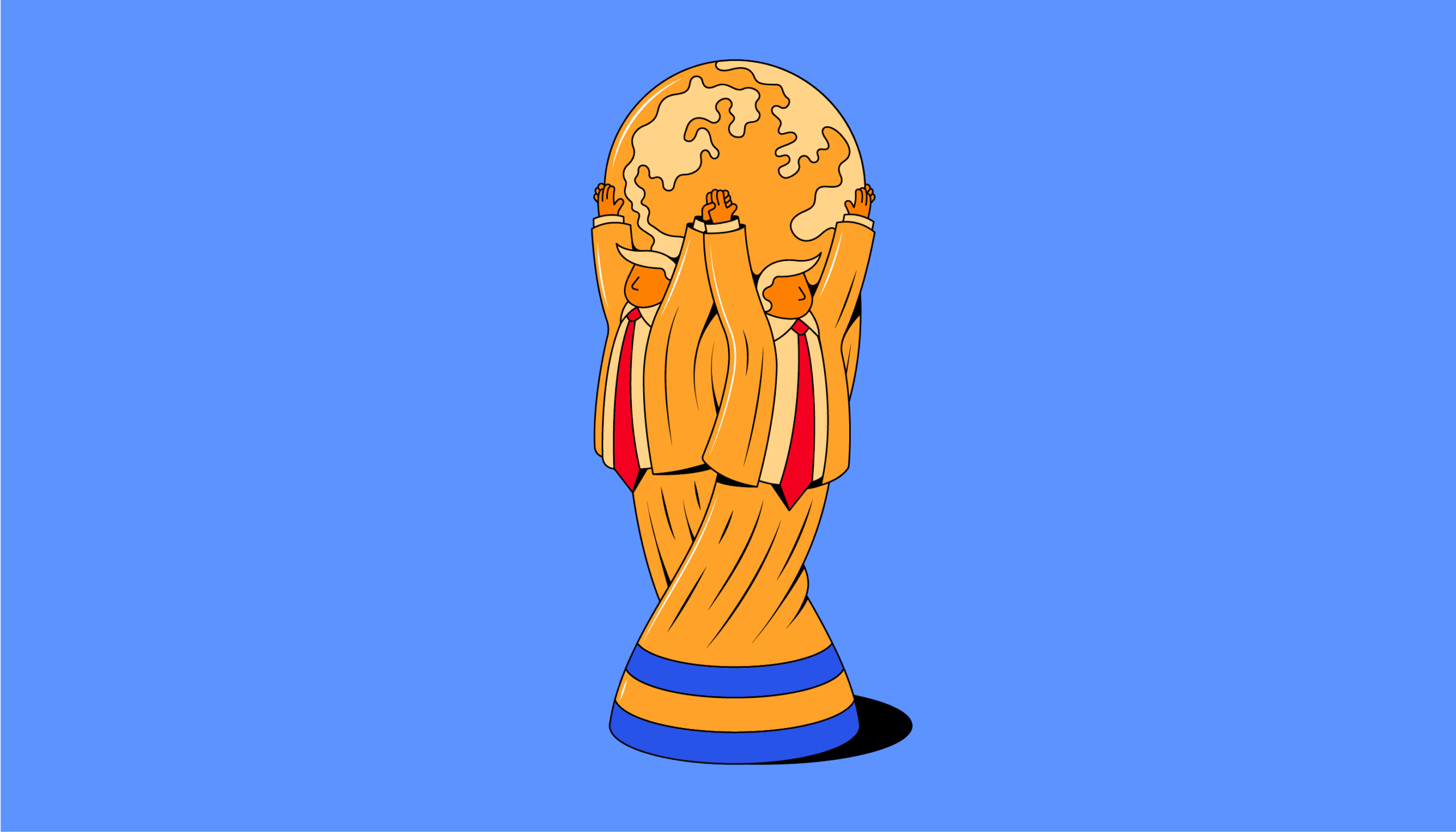
The crackdown added to a growing list of potential complications that observers foresee bedevilling the tournament, from the far-fetched, such as the idea that Trump might rename the trophy the “Roy Cohn Cup,” to the highly plausible or already pertinent: long wait times for visas, exacerbated by the DOGE cuts (so much for “CERTAINTY”); the horror stories from the border that are leading tourism to falter; Trump’s wider crackdown on immigration, including, effective this week, his new, far-reaching travel ban (so much for “OPPORTUNITY”); and tariff-induced price uncertainty that has contributed to deeply troubled relations between the U.S. and its co-hosts (so much for “UNITY”). During the planning meeting, Infantino seemed to speak the words “Canada” and “Mexico” as if they were an afterthought; Trump noticed and said, “That’s the way it’s supposed to be.” Human-rights groups have expressed fears about the treatment of the L.G.B.T.Q. community and the press; there have been calls for a boycott. Already, the tournament has acquired various unflattering monikers: the “Trade War World Cup”; the “ ‘America First’ World Cup”; the “MAGA World Cup”; the “Donald Trump World Cup.”
The tournament could easily become a disaster. But it also seems plausible that Trump will blitz through all the concerns, or at least find ways to sweep them under the rug. (Many autocratic regimes have used sporting events to perform functionality to the world.) Either way, soccer is about to become a much bigger news story in the U.S. The one-year countdown started this week, and a U.S.-hosted “World Cup” for club sides—a trial run, of sorts, for the main event—kicks off tomorrow, amid reports of confusion about the travel rights of visitors, and of undocumented U.S.-based fans opting to stay away from matches for fear of making themselves a target of immigration enforcement. Whatever happens next, the World Cup is a fitting lens through which to understand Trump’s approach to the world, as a second-term Trump doctrine takes shape. And, if the country he runs has strayed from the idealistic language of the bid book on paper, that may make it more similar to other modern-day World Cup hosts, rather than less.
In March, during a different meeting with Infantino at the White House, Trump suggested that the U.S. had never hosted the World Cup before. But it has, back in 1994. I don’t remember the tournament—I was a year old at the time—but, as best as I can tell, the main source of controversy beforehand was soccer’s lack of popularity in the U.S. The event itself was perhaps most memorable for Diana Ross fluffing a novelty penalty kick during the opening ceremony—though that was overshadowed by the O. J. Simpson Bronco chase, which took place later on the same day—and the fading Argentinean superstar Diego Maradona being sent home after failing a drug test. By far its darkest moment occurred not on U.S. soil but in Colombia, where Andrés Escobar was murdered after returning home from scoring an own goal that helped eliminate his country.
In the buildup to the next World Cup, Trump’s immigration policies have sometimes clashed very directly with the world of soccer. After the Administration deported hundreds of Venezuelans to a brutal mega-prison in El Salvador, it emerged that one of them, Jerce Reyes Barrios, had been a professional goalkeeper before moving to the U.S.; a tattoo that officials apparently interpreted as evidence of his membership in a brutal gang was actually a motif representing the top Spanish soccer team Real Madrid. In April, women’s players from Venezuela and Zambia who play for club sides in the U.S. did not leave the country to represent their national teams, amid uncertainty about whether they would be able to get back in. Then, last week, in an executive order, Trump announced full or partial travel restrictions on citizens of nineteen countries, several of which could feasibly qualify for the 2026 World Cup. (Iran has qualified already.) The measure contained an explicit exemption for players, staff, and “immediate relatives” of World Cup teams. But there didn’t appear to be any such exceptions for supporters. Whatever the specifics, the order plainly conflicted with the promise of an open, welcoming tournament. Its representation of Trump’s America First priorities brought to my mind a question that Aaron Timms posed in the Guardian earlier this year, when he asked whether soccer can “continue to be a globalizing force in a deglobalizing world.”
Aggressive nativism is a core plank of Trump’s world view, but his approach to foreign affairs is more complicated than this alone. Although his instincts might be more isolationist than those of his recent predecessors, he nonetheless seems to see himself as the main character of the world, standing astride a competition of nations that runs mostly on the basis of self-interest, but that also, because this is Trump, has a reality-TV sheen to it, with winners getting his favor and losers getting performatively thrashed in front of the cameras. The World Cup shines a light on this dynamic, too, and might even be a useful metaphor for it. Asked, in March, how U.S. tensions with Canada and Mexico might affect the tournament, Trump suggested that they would make it “more exciting,” adding, “Tension’s a good thing”; in May, upon learning that Russia is prohibited from taking part, Trump said that reversing the ban could be a “good incentive” to encourage the country to make peace with Ukraine. And, whereas no one remembers the 1994 World Cup for Bill Clinton, Trump is already claiming ownership of the 2026 edition; Leander Schaerlaeckens, writing in the Guardian, went so far as to predict that it would be “leveraged for the glorification of a leader to a degree not seen since Benito Mussolini dominated the 1934 World Cup in Italy.”
Trump’s foreign policy is guided not only by his exaltation but by financial interests. During his first foreign trip since returning to office, to the Gulf, he announced astronomical investment deals and was dogged by the news that he’d agreed to accept a luxury plane from Qatar, which even some of his diehard supporters seemed to see as a brazenly corrupt act. Among those who joined the trip was Infantino, who, beyond direct World Cup-related business, has reportedly struck up a warm friendship with Trump. (He also attended the Inauguration in January.) Infantino was late to a FIFA congress in Paraguay because he attended the Gulf junket, leading European soccer officials to accuse him of prioritizing his “private political interests,” but there were some soccer-related matters to attend to, including a ceremony to transfer the World Cup to the U.S. from Qatar, the previous host. Indeed, if the U.S. has pivoted toward the Gulf under Trump, FIFA has done something strikingly similar; Qatar was awarded the tournament in 2022, and Saudi Arabia will host it in 2034, the logical culmination of the country’s aggressive push to conquer the global sporting scene. It’s a far cry from the nineties, when the countries to host the World Cup, apart from the U.S., were Italy and France. There’s a metaphor in that, too.
In recent weeks, various foreign-policy commentators have tried to articulate a Trump doctrine. I think that it’s still hazy—and that Trump might not be coherent enough to deserve such schematic treatment—but something he said in Saudi Arabia last month might be the best distillation so far. “In recent years, far too many American Presidents have been afflicted with the notion that it’s our job to look into the souls of foreign leaders and use U.S. policy to dispense justice for their sins,” he said. “I believe it is God’s job to sit in judgment. My job [is] to defend America and to promote the fundamental interests of stability, prosperity, and peace.” Much has changed since the early days of Trump’s first term, but buzzwords still come in threes.
On Trump’s first foreign trip to the Gulf, in 2017, he spoke in similar terms. Back then, FIFA, for all its talk of core values, was already facing loud criticism for awarding the rights to host the World Cup to Qatar, which has persecuted dissidents and L.G.B.T.Q. people, and where migrant laborers died in the process of getting the venues ready. In 2022, when that tournament finally rolled around, Infantino lashed out at the critics, in remarks that are best remembered for baffling gestures of solidarity—“Today I feel gay. Today I feel disabled. Today I feel a migrant worker.”—that were quickly mocked and memed. But something Infantino said after was perhaps more telling: “For what we Europeans have been doing in the last three thousand years around the world, we should be apologizing for the next three thousand years before starting to give moral lessons to people.” Call it the Infantino doctrine. ♦